

Intents Ecosystem Landscape: Mapping the Future of DeFi
Content
Introduction
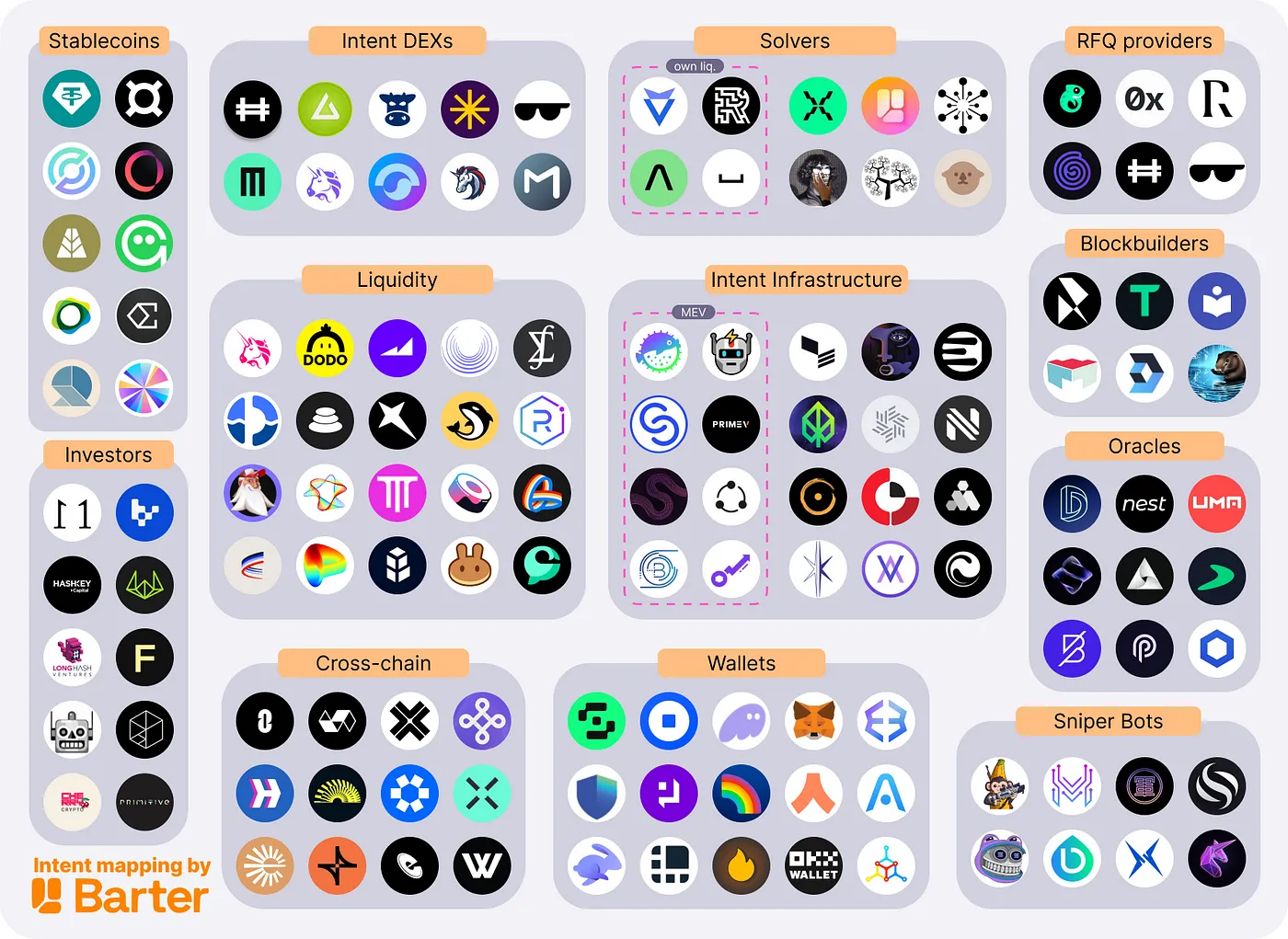
Our team sincerely hopes that the old-school DeFi community is as tired of memes as we are, so we’ve prepared an Intent Landscape Mapping. It’s been a while since Intents have been in the spotlight, but we remain 100% committed to this narrative. Our plan is to unveil various Intent primitives and showcase new use cases for intents in a series of posts. But first, let’s quickly recap what we know about Intents and why they matter.
Intents represent a new way of interacting with blockchain applications, focusing on user-defined goals rather than rigid transaction mechanics. Unlike traditional transactions, which require users to specify every detail and interact directly with smart contracts, Intents allow users to declare their goals through a signed message and then outsource the process to third parties. These third parties can choose the best computational path to fulfill the user’s objective while ensuring that certain parameters — such as gas fees and slippage — remain within acceptable limits. By abstracting away the complexities of transaction construction, Intents significantly improve the user experience, offering a more flexible, efficient, and less error-prone interaction with decentralized protocols.
The flexibility of Intents allows for a higher degree of computational efficiency and expressivity, opening the door to more sophisticated solutions like multi-transaction bundling and cross-domain operations. Instead of interacting with fragmented protocols, users can simply state their desired outcome, and the system finds the best way to achieve it. This reimagines blockchain interactions to be as user-friendly as traditional software, removing friction and creating a more fluid, goal-driven DeFi experience. Intents offer a path forward for minimizing inefficiencies like MEV (Maximal Extractable Value), improving UX, and ultimately transforming how decentralized applications cater to the needs of their users.
Intents are already transforming DeFi, and Dapps will need to move in this direction or risk losing market share. We’re going to share our predictions for Intents in DeFi for 2025 soon, but before that, let’s take a look at how much the space has grown and how many projects are actively building here. This is the first iteration of our Map, so we’ll add more projects and possibly unbundle a few categories as we refine it. If we missed your team, please accept our apologies — reach out and we’ll be sure to add you in the next version!
Let’s take a closer look at the key categories that shape our Intent Landscape Mapping. Each one contributes to the broader vision of streamlined, goal-driven DeFi interactions — and, ultimately, a future without MEV.
1. Intent DEXes
These decentralized exchanges go beyond traditional AMM pools or Aggregators, allowing users to specify the outcome they want — for instance, swapping one token for another at the best available price or under certain slippage thresholds. By focusing on user-defined objectives rather than rigid transaction parameters, Intent DEXes can automatically source liquidity, find favorable routes, and potentially protect users from harmful front-running or MEV.
2. Intent Liquidity
We emphasized on most popular AMMs, Protocols and more sophisticated liquidity management systems. In order to be profitable, liquidity provision requires complicated strategies and constant rebalancing. Ideally, Intent-based liquidity solutions should be very flexible and delegate the underlying tasks to smart contracts or other protocols.
3. Stablecoins
Stablecoins are crucial for maintaining predictable value in the ever-volatile crypto market. As veins of the industry and liquidity pools and a relatively safe heaven for yield generation those projects help grow DeFi and Intents in general.
4. Solvers
In an intent-based system, “solvers” are the engines that figure out how to execute a user’s goal most optimally. In general, Solver is a Mix of a Market Maker, an MEV bot, and an Aggregator. Solvers connect various liquidity sources, protocols, and transaction submission strategies to deliver the desired result while minimizing gas costs and MEV exposure. By combining logic, data, and off-chain computation, solvers bring an extra layer of efficiency and user protection to the ecosystem. We separated solvers by 2 subcategories: algorithmic ones and market-making ones.
5. RFQ Providers
Request-for-Quote (RFQ) providers play a key role in enabling personalized pricing and close to order book experience for DeFi. It allows more liquidity into the system and more complex strategies for traditional market makers.
6. Block Builders
As MEV concerns grow, block builders that align with user intents become a critical part of the stack. They can structure transactions to minimize sandwich attacks or front-running, taking into account the user’s end goal rather than just the raw transaction data. We are all relatively familiar with the problems of current system, but it is important to understand current leaders and this niche dynamics.
7. Oracles
Oracles supply vital data — like prices, interest rates, and cross-chain information — that solvers and other intent-based protocols rely on. Accurate, timely data is essential for executing user intents correctly. As oracles get more sophisticated (real-time updates, privacy-preserving feeds), they will help create more reliable outcomes for every intent-driven transaction.
8. Sniper Bots
Historically, sniper bots exploit inefficiencies and target new coins that were just created on-chain. The vast majority of activity is centered around Solana Ecosystem. In an intent-focused model, however, the user’s goal is central, and transaction details can be abstracted away. This opens up possibilities to open up the transaction execution to solvers and we have already seen first bots moving towards the intent mechanisms.
9. Wallets
Wallets are the frontline for user experience. In an intent-based wallet, a user might say, “send 2 ETH worth of stablecoins to buy a meme coin, sell it after it reaches certain price point and put those profit into yield generating network,” and the wallet will handle the routing and conversions automatically. By lifting the complexity off the user’s shoulders, Intent Wallets become crucial in driving adoption, making DeFi more intuitive for both veterans and newcomers.
10. Cross-Chain Solutions
Generally, 2 biggest use cases of Intents are Swapping and Bridging. And those are very different niches with different rules and actors. As multi-chain ecosystems grow, navigating across different blockchains can be cumbersome. Intent-based cross-chain solutions allow users to easily move liquidity different layers with minimal fees. These protocols take on the headache of bridging and finalizing transactions securely, drastically improving the user experience in multi-chain DeFi.
11. Active Investors
Finally, we can’t overlook the role of investors and VCs who are putting capital and resources behind intent-focused ventures. Their support accelerates development and helps founders experiment with fresh solutions. As the momentum builds, these investors will shape how quickly intents become the de facto model for DeFi interactions.
Conclusion
Our mapping is far from Ideal. Please reach out to us to help make it better! We need to add more projects and possibly unbundle a few categories. The infrastructure category is a tough one to analyze atm, encompassing everything from specialized blockchains and Layer 2 networks to new block-building techniques, rebalancing mechanisms, or protocol tooling that doesn’t quite fit anywhere else.
Intents Will Define DeFi’s Future!
If you want an Interactive version of the Map, you can find it here
We firmly believe that Intents are the key to delivering a frictionless, user-centric, and MEV-resistant DeFi environment. MEV DELENDA EST.
