

DeFi Trends for 2026: Stablecoins, Execution, and Wallets
Content
Introduction
Throughout 2025, Barter conducted a multi-domain analysis of key trends reshaping DeFi architecture. Using a combination of proprietary research, on-chain data and secondary reports from leading institutions, we examined how liquidity flows, execution layers, and user expectations are shifting across the ecosystem. In the final section, we highlight how Superposition fits this emerging architecture not as a competing interface, but as a native liquidity layer designed for wallet-first, solver-integrated, MEV-resistant execution.
Stablecoin Settlement Flows and Execution Constraints
Recent empirical work frames stablecoins less as "crypto-native liquidity" and more as an emerging settlement substrate for digital commerce. RWA.xyz documents stablecoin supply expanding into the ~$250B range by mid-2025, suggesting that on-chain dollars have reached a scale where market structure, not just adoption, becomes the binding constraint [1].
a16z's 2025 stablecoin analysis complements this stock measure with flow evidence: stablecoins processed $33T in on-chain transaction volume over the 12 months to mid-2025 with explicit benchmarking against legacy payment rails (PayPal and Visa) to contextualize magnitude.
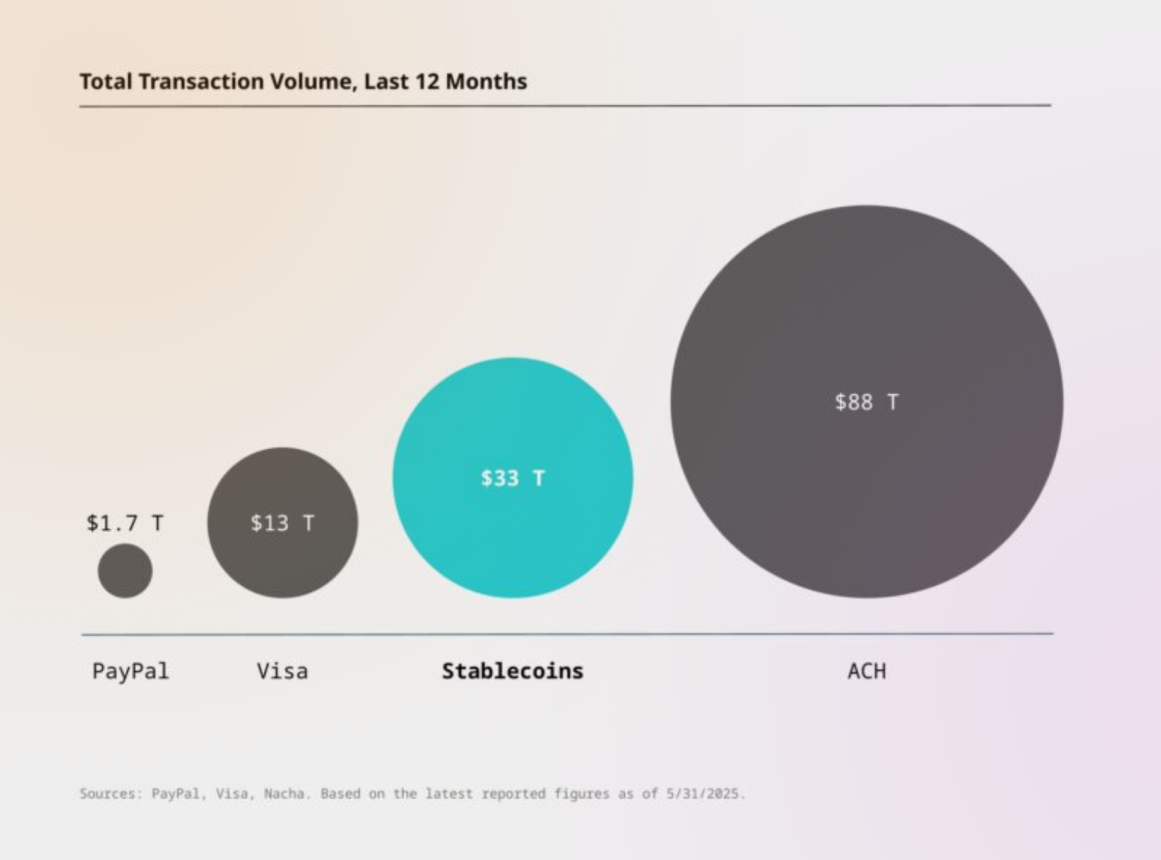
Bubble chart comparing annualized transaction volumes across PayPal, Visa, stablecoins, and ACH | Data: a16zcrypto.com
Crucially, they also report an adjusted estimate of >$9T in "real usage" after excluding internal or non-economic flows, which supports the interpretation that stablecoin throughput is not reducible to exchange churn. On the reserve side, it notes that stablecoin issuers collectively hold approximately $128B in U.S. Treasuries, and cites Citi's projection that this could reach $3.7T by 2030 under high-adoption trajectories, underscoring the degree to which stablecoins increasingly interface with sovereign collateral markets. (A secondary summary of related a16z "State of Crypto 2025" framing is also discussed in [3].)
The result is a coherent macro thesis: stablecoins are moving simultaneously along three axes that define monetary infrastructure: scale (supply), throughput (settlement volume), and institutional linkage (reserve composition) [1][2].
However, once stablecoins function as a settlement layer, stablecoin-to-stablecoin exchange becomes a market-critical primitive rather than a peripheral DeFi activity. Barter's State of Stable Swaps provides a microstructure lens on this transition. As of April 2025, stable-to-stable swaps account for 31.5% of total DEX volume (≈$16.6B/month) while comprising <5% of trade count [4]. This asymmetry implies that stable swaps concentrate value into relatively few, large tickets, making execution quality disproportionately important: small price impacts translate into meaningful basis-point losses at scale. Barter's execution analysis quantifies the magnitude of these frictions: $8.1B of stable swaps experienced >0.1% slippage, and $930M exceeded 1% slippage.
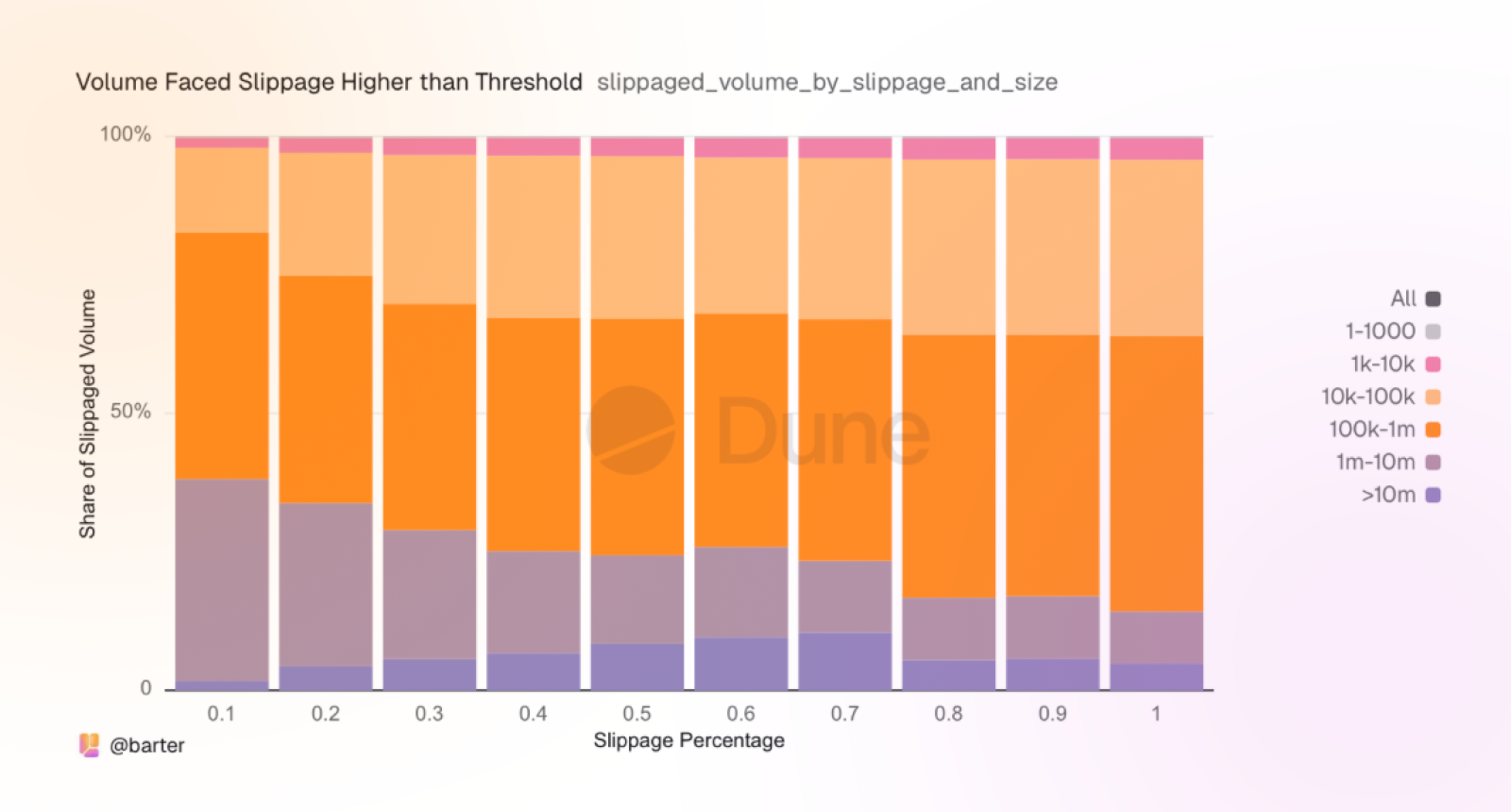
The share of retail stable swaps volume encountered a slippage percentage equal or greater than a threshold breakdown by a volume of swap over the past year (May 2024 - Dec 2025) | Data: dune.com
In parallel, the segment's adversarial exposure has intensified. Barter reports that the share of stable swaps within sandwich activity rose from 29.7% (Dec 2024) to 53.8% (May 2025), peaking at 67.8% (Mar 2025). Consistent with these dynamics, Barter attributes 47.0% of stable-swap volume to MEV plus arbitrage, alongside pronounced fee compression (average 0.011%, volume-weighted 0.005%). Within this framework, 80.2% "toxic MEV share" for Uniswap v4 stable swaps, as defined by their classification methodology.
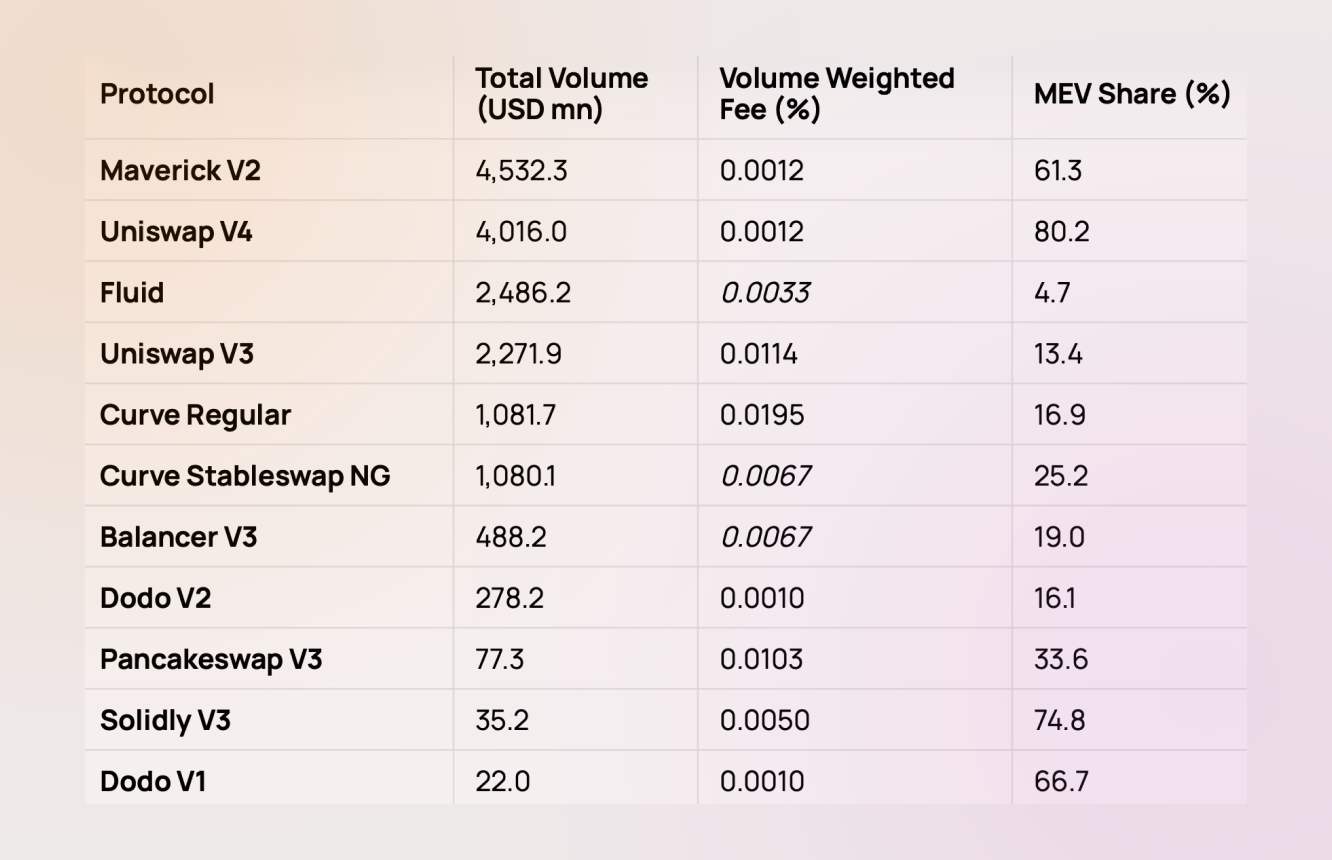
Top protocols by total stable swaps volume with corresponding share of toxic MEV for April 2025 | Data: barterswap.xyz
Taken together, the evidence supports a tight conclusion. Stablecoins are scaling into a settlement layer with payment-rail-level throughput and increasingly sovereign-linked collateral backing [1][2]. Yet the execution layer responsible for stable swaps remains structurally misaligned with that role: measurable slippage persists even in ostensibly "stable" exchange, and MEV-driven microstructure effects increasingly concentrate precisely where parity-priced execution should be most reliable [4].
The Rise of Private Liquidity (PMMs and Prop AMMs)
Private liquidity became one of the big trends of 2025. As on-chain volumes grew and trade sizes increased, more flow started moving away from public AMMs toward execution venues optimized for discretion and price quality. This shift has been most visible in the rise of private market makers (PMMs)—professional market makers that price trades off-chain and only settle on-chain via aggregators or RFQ-style integrations. By avoiding public liquidity curves, PMMs dramatically reduce price impact and information leakage, making them especially attractive for large and institutional trades. On Ethereum, PMMs still account for a minority of overall DEX volume, but they dominate where execution quality matters most: the average PMM trade is 3.8x larger than an AMM swap, and an estimated 58–80% of all trades over $100k are now routed through private liquidity — particularly stablecoin pairs, which are highly sensitive to slippage [6].
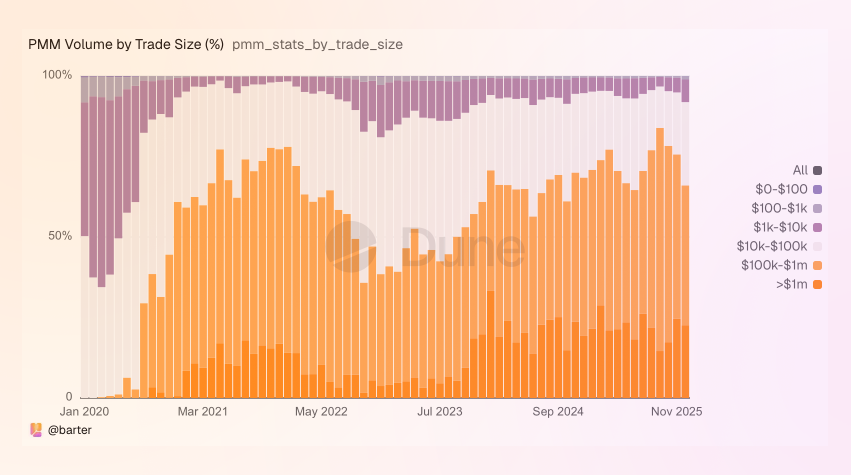
PMM volume number by fill size | Data: dune.com
The same trend has played out even more dramatically on Solana, where proprietary AMMs have emerged as backend-only liquidity sources. Enabled by Solana's high throughput and low fees, these prop AMMs grew from roughly 7% of DEX volume in late 2024 to the majority by September 2025, overtaking traditional AMMs entirely. While the implementation differs, the takeaway is the same across chains: as DeFi matures, liquidity is becoming more professionalized, and for large trades, private liquidity is increasingly the default rather than the exception.
Aggregators, Wallets & Solvers: The New DeFi Distribution Layer
Crucial is the evolution of how users access liquidity. In 2025, the typical DeFi user isn't manually picking a single DEX for a trade, they're using an aggregator or wallet interface that sources liquidity from many venues. Aggregators (1inch, Velora and others) now drive a large share of swaps activity. Over the past year, roughly 25-30% of total DEX volume on Ethereum has been routed via aggregators rather than direct UI swaps [6]. The total volume forwarded by aggregators grew 2x from the start of the year by Q4 of 2025 - user orderflow is consolidating in these smart order routers that compete to deliver the best execution. DEXs now win by offering the best price to aggregators' APIs, not by attracting individual traders to their site [6]. This dynamic has fueled the complexity race (Uniswap v3's concentrated liquidity, Curve v2's custom curves, etc.), as well as the emergence of new DEX designs purpose-built for aggregators.
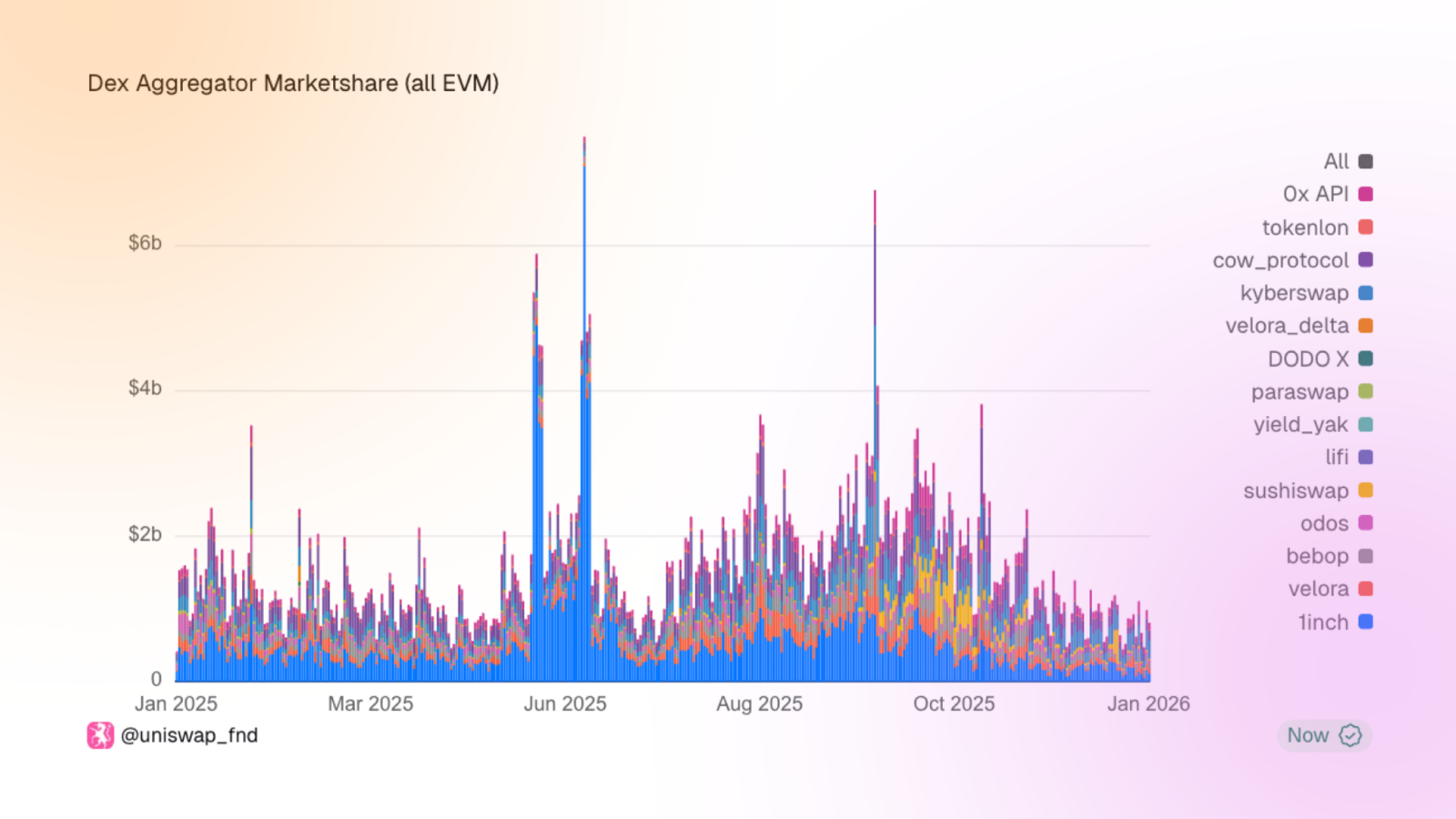
Stacked time series of routed volume by aggregator across EVM | Data: dune.com
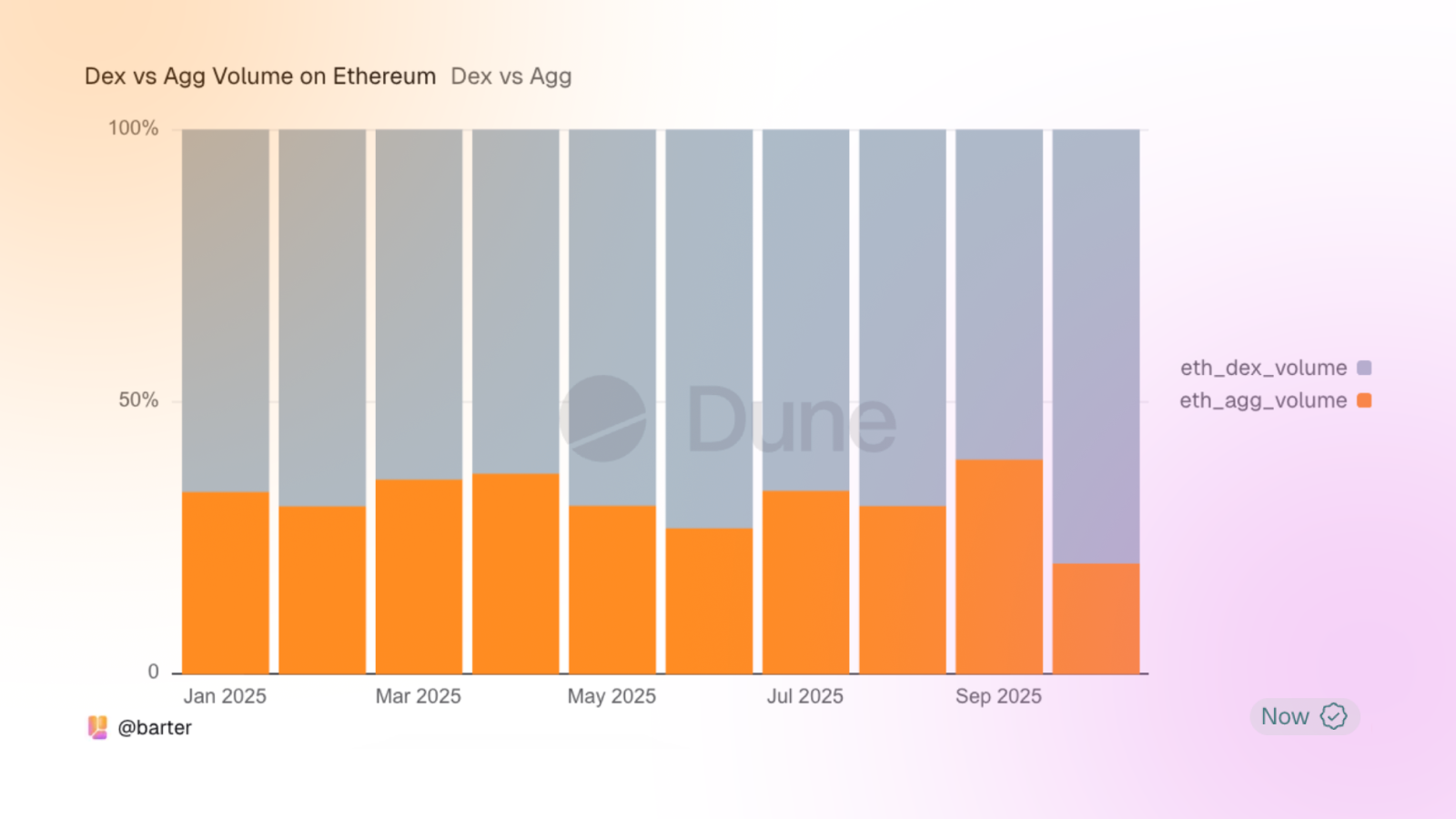
Ethereum volume split: direct DEX vs aggregator-routed | Data: dune.com
A related innovation is the move to solver-based architectures. Rather than simply splitting orders across pools, some protocols (like CowSwap, Uniswap X and others) use off-chain auctions among solvers to batch and match orders, often integrating directly with PMMs. Solvers compete to find the best route (through different counterparties) to provide the best price for users.
Even wallets have joined the fray: popular wallet apps (MetaMask, Coinbase Wallet, Zerion, etc.) often have built-in swap features that use these aggregators under the hood, the wallet simply gives an intent. This trend also sets the stage for more exclusive integrations between aggregators and liquidity providers. We're now seeing "Aggregator 2.0" strategies: some aggregators are onboarding their own router-native liquidity pools or RFQ systems that only their router can access. For example, KyberSwap introduced a private RFQ system and even custom Uniswap v4 pools (via "FairFlow" hooks) that only Kyber's router can tap [6].
By October 2025, about 21.8% of KyberSwap's routed volume was using such private liquidity (including both its own pools and direct PMM integrations). It is obvious: if an aggregator can secure exclusive better pricing via its own liquidity, it can win more user flow.
Swaps execution field is changing, it's no longer enough to launch a shiny AMM UI and expect users to come, one must win over the aggregators, solvers, and wallets that sit between liquidity and users. This is precisely the context where Barter works.
From Yield Farms to On-Chain Treasuries: The Shift to Passive Yield
DeFi is also undergoing a quieter transformation on the investment side: a shift toward passive yield infra. In the early 2020s, yield farming and speculative token APYs were all the rage. But by 2025 attention has turned to bringing traditional yield instruments on-chain: stablecoins, on-chain Treasuries, money market funds (MMFs) and other real-world asset (RWA) yield products.
The numbers back this trend. By mid-2025, tokenized treasuries and money market products reached $9B in assets on-chain (up 80% from just the start of that year) [7]. Multiple firms now offer "T-bill stablecoins" or notes: e.g. Ondo Finance's OUSG fund, Circle's Reserve Fund (via BlackRock), and others. Even big TradFi players jumped in – in late 2025 JPMorgan launched a tokenized money market fund on Ethereum [8]. These allow crypto users to park dollars in yield-bearing instruments without leaving the blockchain.
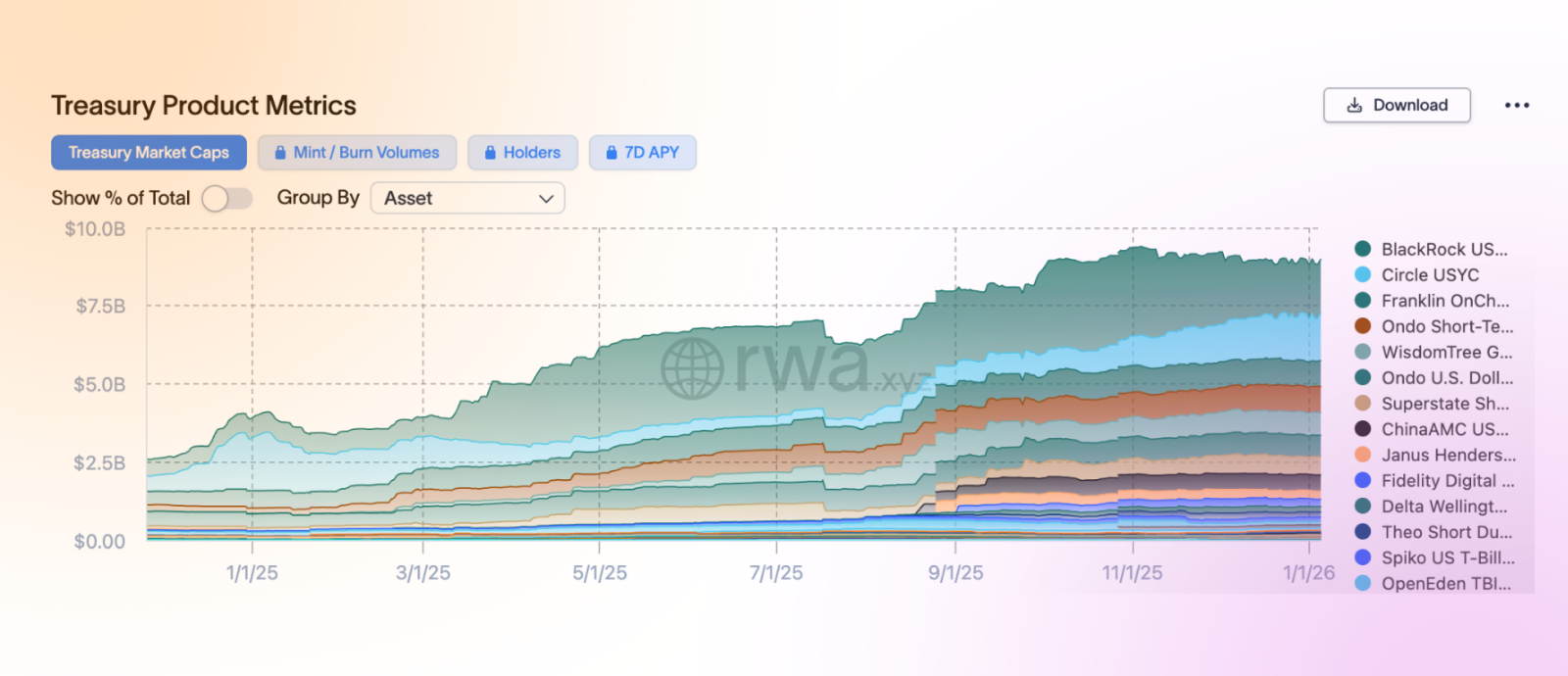
Area chart tracking growth in tokenized treasury products and related on-chain yield instruments | Data: rwa.xyz
The common theme is passive income with low risk: essentially bringing the money-market fund experience into DeFi. For users, why hold plain USDC earning 0% when you could hold a tokenized T-bill with 5% APY? For users access to these yield-bearing assets opens the door to combine yield with liquidity provision. We're beginning to see designs where liquidity providers can earn base yield (from something like T-bills) plus trading fees on top.
Account Abstraction and the Verticalization of Wallets
By 2025, crypto wallets have become execution environments. Dune's Wallet Report v2 shows that a growing share of on-chain activity now flows through smart wallets — interfaces with built-in batching, gas abstraction, and one-click DeFi actions [9]. These wallets compress complex operations (like swaps and stakes) into a single confirmation, removing friction.
Adoption is consolidating around high-throughput environments. Coinbase's Base network handled 87% of all smart wallet UserOps by April 2025, while frameworks like Safe and Biconomy power most deployments. Forbes calls wallets the new "superapps" of crypto: swap, stake, lend — all in one place [10]. Users increasingly expect to earn, move, and interact without leaving the wallet or transferring assets into separate vaults.
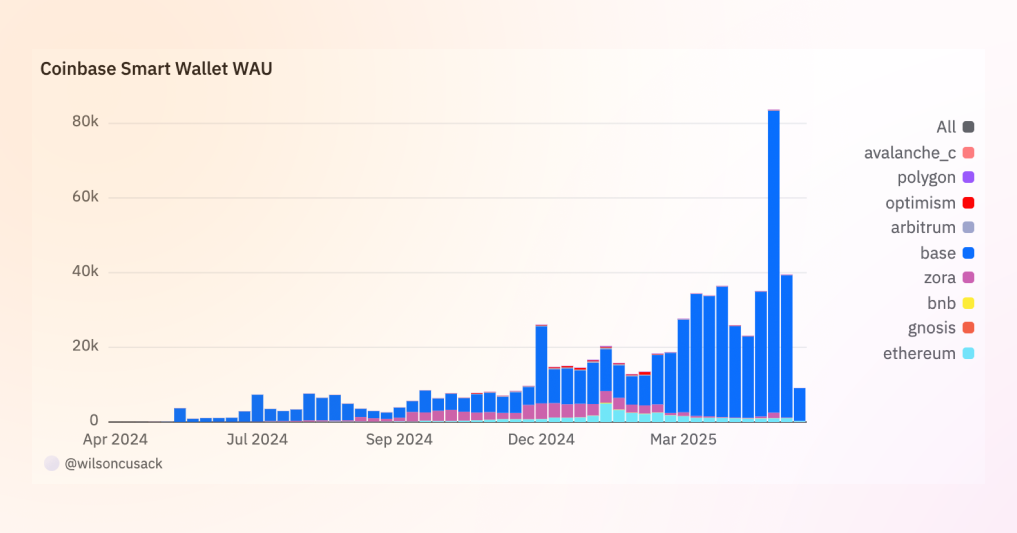
Stacked bars showing weekly active users for Coinbase Smart Wallet segmented by network | Data: dune.com
Wallets are now the default access layer for DeFi curating intent, routing flow, and controlling the user journey.
Superposition as a Structural Response to 2025–2026 DeFi Market Dynamics
Superposition by Barter is positioned to map cleanly onto the dominant 2025-2026 structural narratives not as a new venue, but as a distributed liquidity layer designed for the execution and distribution surfaces that increasingly control orderflow.
First, the "stablecoins as settlement" thesis implies stable swaps become core infrastructure, where execution quality matters disproportionately because flows are large and parity-sensitive. Superposition targets this directly through a stable-swap architecture intended to clear pegged assets near parity with coordinated quoting and on-chain atomic settlement, reducing the arbitrage surface that emerges when pool prices lag external markets.
Second, the market has shifted toward router- and wallet-mediated execution: smart-account UX compresses multi-step DeFi into single confirmations, and the wallet layer increasingly curates routing and distribution. Superposition is integration-first by design, enabling it to be consumed through Barter's routing stack and wallets rather than requiring users to migrate to a dedicated interface.
Third, stable-swap microstructure has become increasingly adversarial under fee compression, with Barter's research documenting rising sandwich concentration and a large MEV/arbitrage component in stable-swap volume. Superposition's quote-driven, solver-coordinated execution model aligns with the broader move toward protected, intent-style execution pathways that reduce mempool exposure relative to public AMM interaction patterns.
Finally, the ecosystem's push toward capital efficiency favors liquidity models that minimize idle TVL while preserving execution quality. Superposition's distributed liquidity approach keeps liquidity in user wallets and commits it to execution via permissions and routing rather than permanent pool lock-up, aligning with the observed trend toward tighter liquidity relationships between routers and liquidity sources.
Taken together, Superposition is best interpreted as an infrastructure component designed to satisfy the requirements implied by the current cycle: settlement-scale stablecoin flows, wallet-first distribution, solver/routing-centric execution, and capital efficiency under fragmentation.
Resources
https://rwa.xyz/blog/the-stablecoin-report-everyones-been-waiting-for
https://a16zcrypto.com/posts/article/stablecoins-data-users-onboarding/
https://www.fintechwrapup.com/p/deep-dive-what-a16zs-state-of-crypto
https://www.coindesk.com/business/2025/12/15/jpmorgan-launches-tokenized-money-market-fund-on-ethereum-as-wall-street-moves-onchain-report
https://www.forbes.com/sites/digital-assets/2025/06/11/3-crypto-wallet-trends-you-cant-afford-to-miss-in-2025/
