

Intent Auctions Breakdown on Top DEXes: How Solvers Compete
Content
Introduction
In DeFi, intents shift the focus from how a transaction is executed to what the user actually wants to achieve. Instead of sending a specific on-chain transaction, a user signs an off-chain intent that defines the desired outcome, for example, “swap 1 ETH for at least 1,600 USDC.”
To make that outcome happen, solvers step in. These are specialized third parties that determine the most efficient way to fulfill a user’s intent, sourcing liquidity and optimizing execution across multiple venues. Barter is currently the only solver integrated with all major intent-based DEXes, giving users the best possible execution across the entire intent ecosystem.
Behind the scenes, every swap functions as an auction, where solvers compete in real time to deliver the best result. Each protocol runs its own auction design, applying unique rules to decide which solver wins.
In this case study, we explore how different auction mechanisms work across leading intent-based platforms such as Cow Swap, UniswapX, 1inch, Velora Delta, and Bebop JAM, and examine how each protocol structures competition, selects the winning solver, and protects users from MEV.
Cow Swap: Fair Combinatorial Auction
CowSwap was the first major decentralized exchange built entirely around intent-based trading. When a user specifies which tokens to trade and in what amounts, the protocol immediately triggers a quoting auction among solvers to determine the most competitive rate. The solver offering the best quote at this stage provides the price displayed to the user. Once the user confirms the swap, a second auction begins, this is where solvers compete to actually settle the trade on-chain.
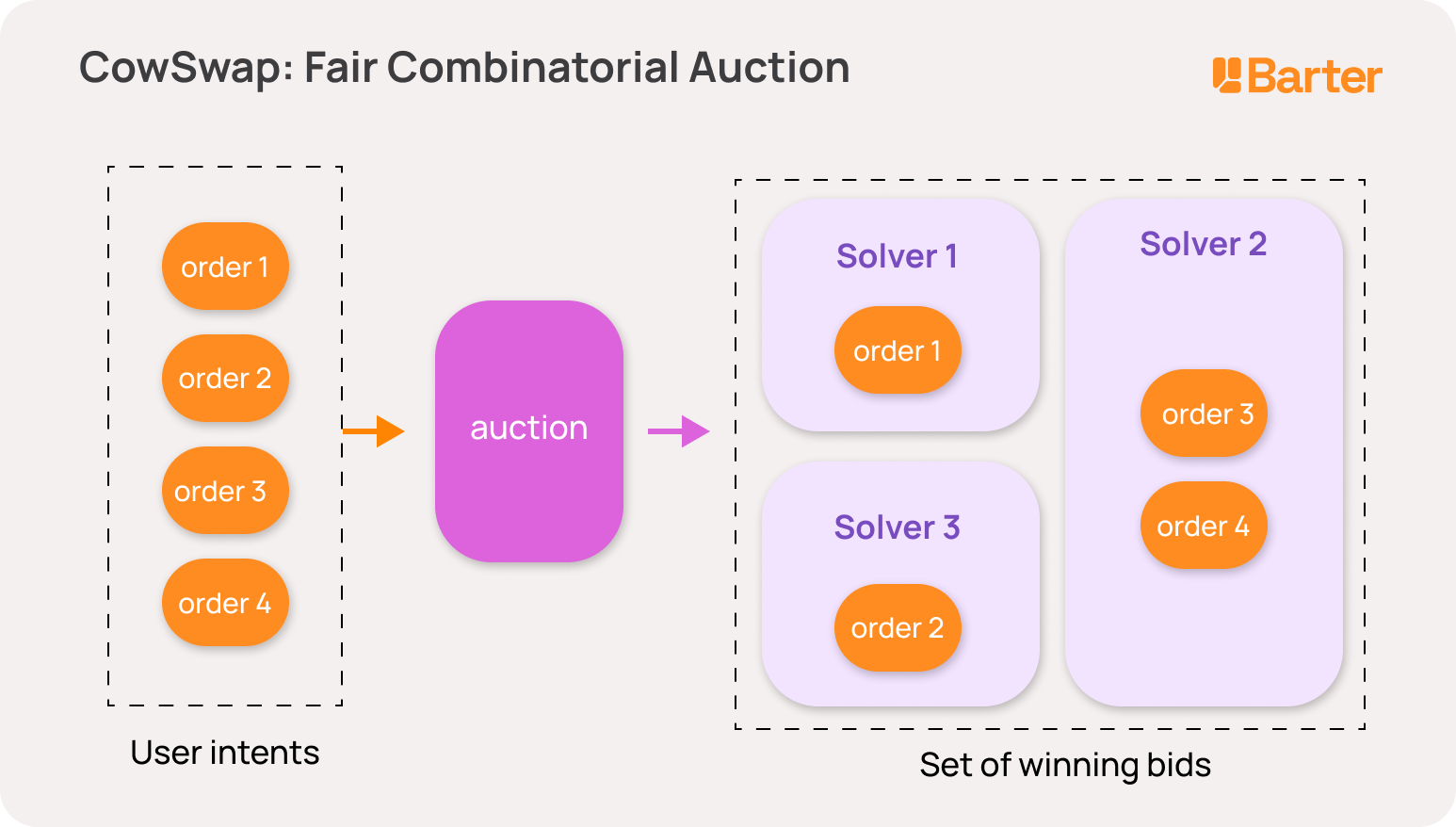
CowSwap pioneered the use of batch auctions for this second phase, collecting multiple user orders and processing them together to achieve more efficient execution and better price discovery. In 2025, this settlement model evolved into the Fair Combinatorial Auction.
During a Fair Combinatorial Auction, user orders are collected over a fixed time window and distributed to solvers. Each solver searches for the most efficient way to execute these orders, either individually or by combining them into batches, and then submits all combinations. From all submitted results, CowSwap selects those that maximize user outcomes across the batch, ensuring that every trader receives optimal execution while maintaining fairness and minimizing MEV exposure.
Velora Delta Auctions
Velora Delta evolved from ParaSwap, transitioning from a classic DEX aggregator into an intent-based execution model. When a user specifies which tokens to trade and in what amounts, Velora’s backend first pre-processes the order and estimates the expected execution price. The user then submits an intent through the Velora interface.
From there, the process unfolds in two stages.
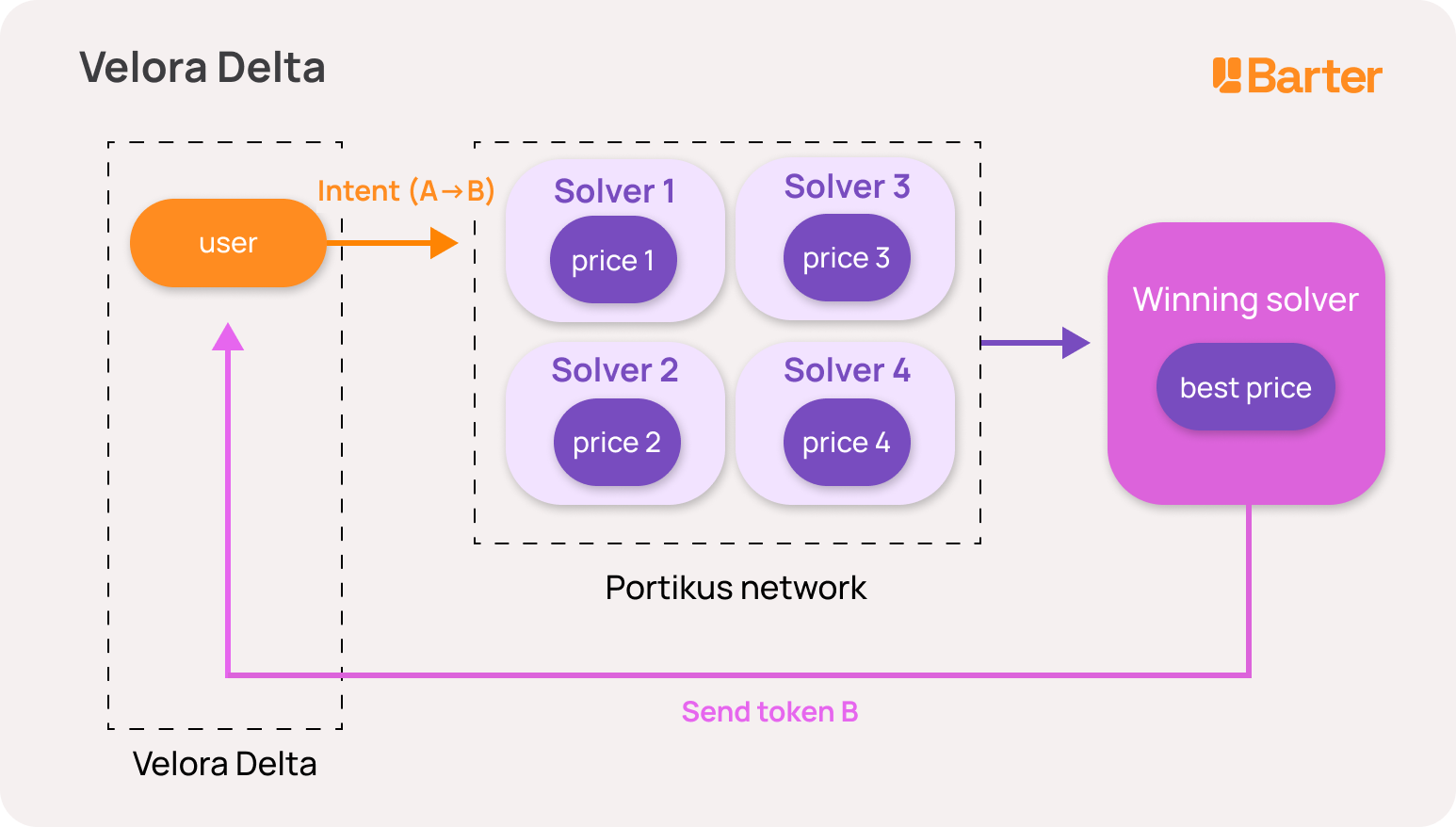
In the first stage, the order is broadcast to the Portikus network, where a group of independent agents (solvers) compete to find the most efficient way to settle it using available liquidity sources. In the second stage, the winning solver executes the transaction on-chain.
The auction winner is determined primarily by which solver delivers the best output—typically the highest amount of the target token. However, when multiple solvers offer similar prices, other factors such as execution speed and reliability influence the outcome. As the Velora team describes it: “Best output is the main driver, but also agent reputation, which is a function of filling rates and the quality of execution.”
To maintain fair and efficient competition, Velora uses a real-time monitoring system that continuously tracks solver performance and adjusts their standing within the network. Solvers that consistently underperform are temporarily downgraded until their execution quality improves, ensuring a healthy and competitive solver ecosystem.
Bebop: JAM Auction
Bebop, incubated by Wintermute and launched in 2022, began as an RFQ aggregator that connected directly with professional market makers. In 2023, Bebop introduced JAM ( short for Just-in-time Aggregation Model) — an intent-based system where independent algorithms compete to provide the best outcome for users. One of Bebop’s key innovations is multi-asset swaps, allowing users to exchange one token for a portfolio of several others within a single transaction.
Originally, Bebop relied solely on RFQ execution: user requests were routed to private market makers, who returned fixed quotes with zero slippage risk. With the introduction of Bebop JAM, that process became more dynamic. When a user submits an order, Bebop’s backend decides whether to route it to professional market makers (PMMs) or to solvers through JAM.
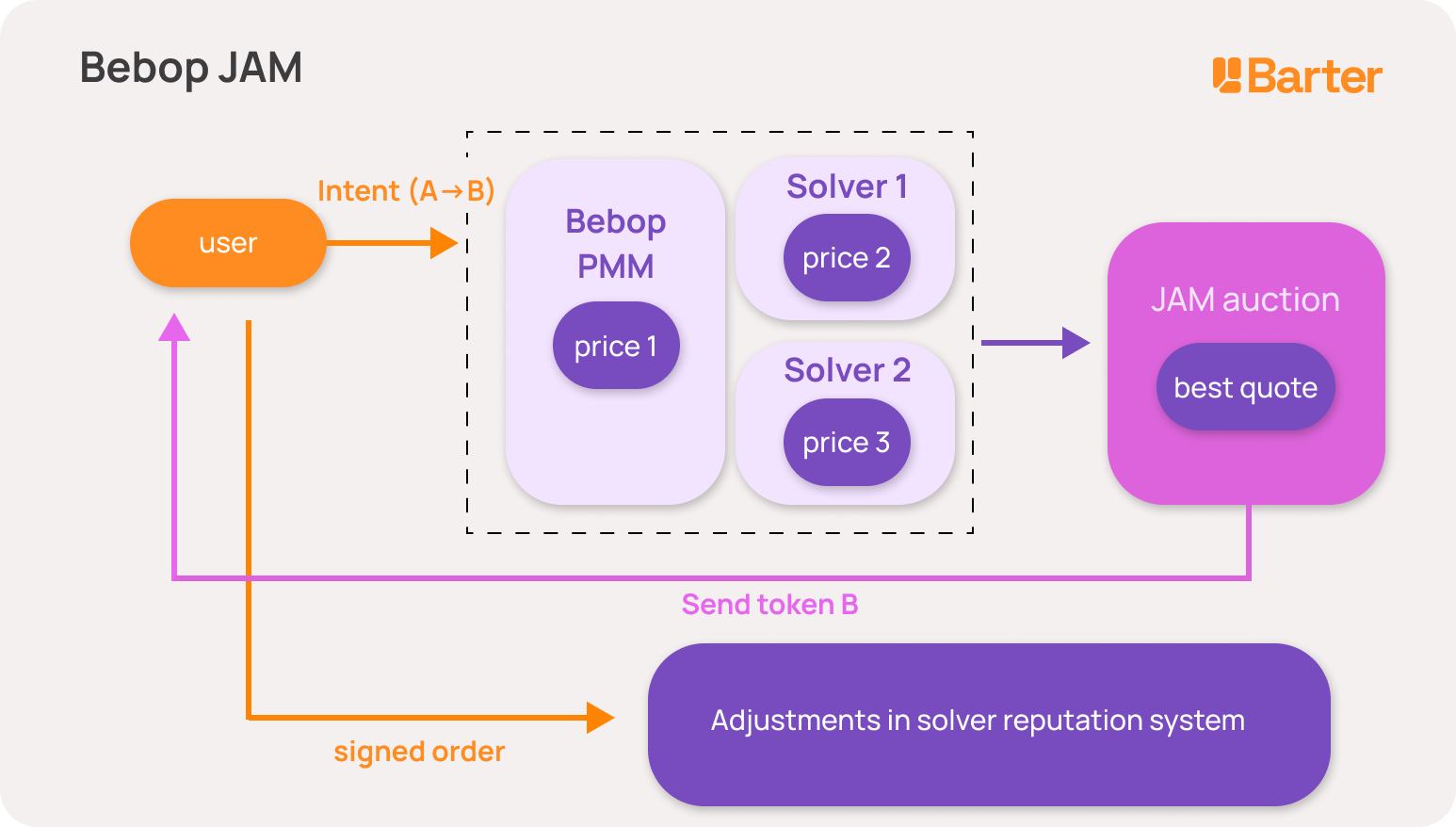
The JAM orchestrator receives the trade parameters (for example, “sell 1,000 Token A for Token B with a maximum slippage of 0.1%”) and broadcasts this intent simultaneously to both connected solvers and Bebop’s internal market makers. Solvers analyze available liquidity sources and design execution routes that maximize the user’s return after gas costs, while PMMs respond with direct RFQ quotes that guarantee execution without slippage or MEV exposure.
The orchestrator compares all responses and selects the best available option, which is then displayed to the user as a final quote. If the user accepts, they sign an off-chain order specifying the minimum amount they expect to receive. For gasless orders, the orchestrator forwards this signed order to the winning solver, who submits the transaction on-chain. The JAM Settlement contract then verifies the signature, confirms that the execution meets the user’s minimum output, and finalizes the swap.
When we asked the Bebop team what sets JAM apart from other intent-based systems, they pointed to three things: speed, autonomy, and reputation. JAM auctions run in about 1.5 seconds, solvers set their own fees instead of relying on protocol rewards, and a reputation system continuously scores their performance to keep competition fair and outcomes consistent.
UniswapX: Exclusive Dutch Auction on Ethereum
UniswapX, introduced by Uniswap Labs in 2023, extends the classic AMM model with an off-chain auction layer for user orders. Users can submit a new type of order called an Exclusive Dutch Order, where they define the minimum amount of tokens they are willing to accept.
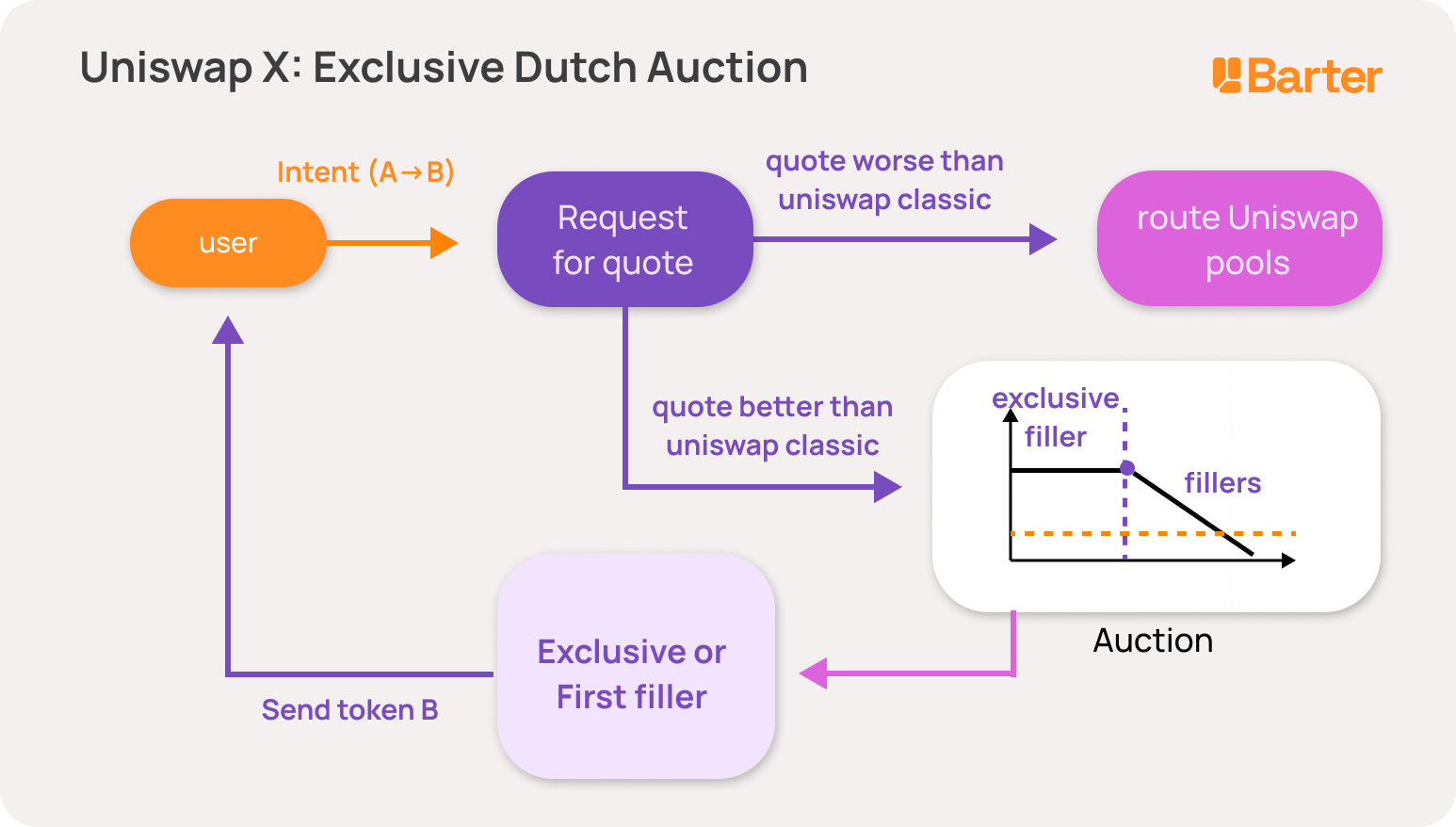
When a user initiates a swap through the Uniswap interface, the system retrieves two quotes in parallel: a standard AMM quote based on Uniswap pools and a UniswapX soft quote from a permissioned group of fillers participating in the RFQ process. If the UniswapX quote offers a better rate, it is highlighted to the user as the optimal route.
Once the user confirms the trade, the order enters the first auction phase. Here, the same set of fillers that provided soft quotes now submit final hard quotes, and the filler offering the most favorable rate earns the exclusive right to execute the order within a short time window. If that filler fails to complete the transaction, the system automatically transitions to the second phase — a Dutch Auction.
In this open phase, the user’s order becomes visible to all fillers in a permissionless competition. The auction begins near the last quoted price and gradually decreases over time. Market makers and searchers monitor this curve and race to fill the order at the most profitable moment, ensuring users receive highly competitive execution.
This two-phase structure creates a clear separation of roles. Quoters (a permissioned group of solvers) participate in the RFQ phase, while any filler can step in during the Dutch Auction fallback, providing a reliable “emergency hatch.” Together, this combination of RFQ and Dutch Auction minimizes failed transactions, discourages unreliable actors, and balances guaranteed pricing with open competition.
Currently, the Exclusive Dutch Auction model operates only on Ethereum. On Arbitrum, UniswapX uses a simplified Dutch Auction, while on Base and Unichain, filler competition relies on Priority Gas Auctions.
1inch Dutch Auction
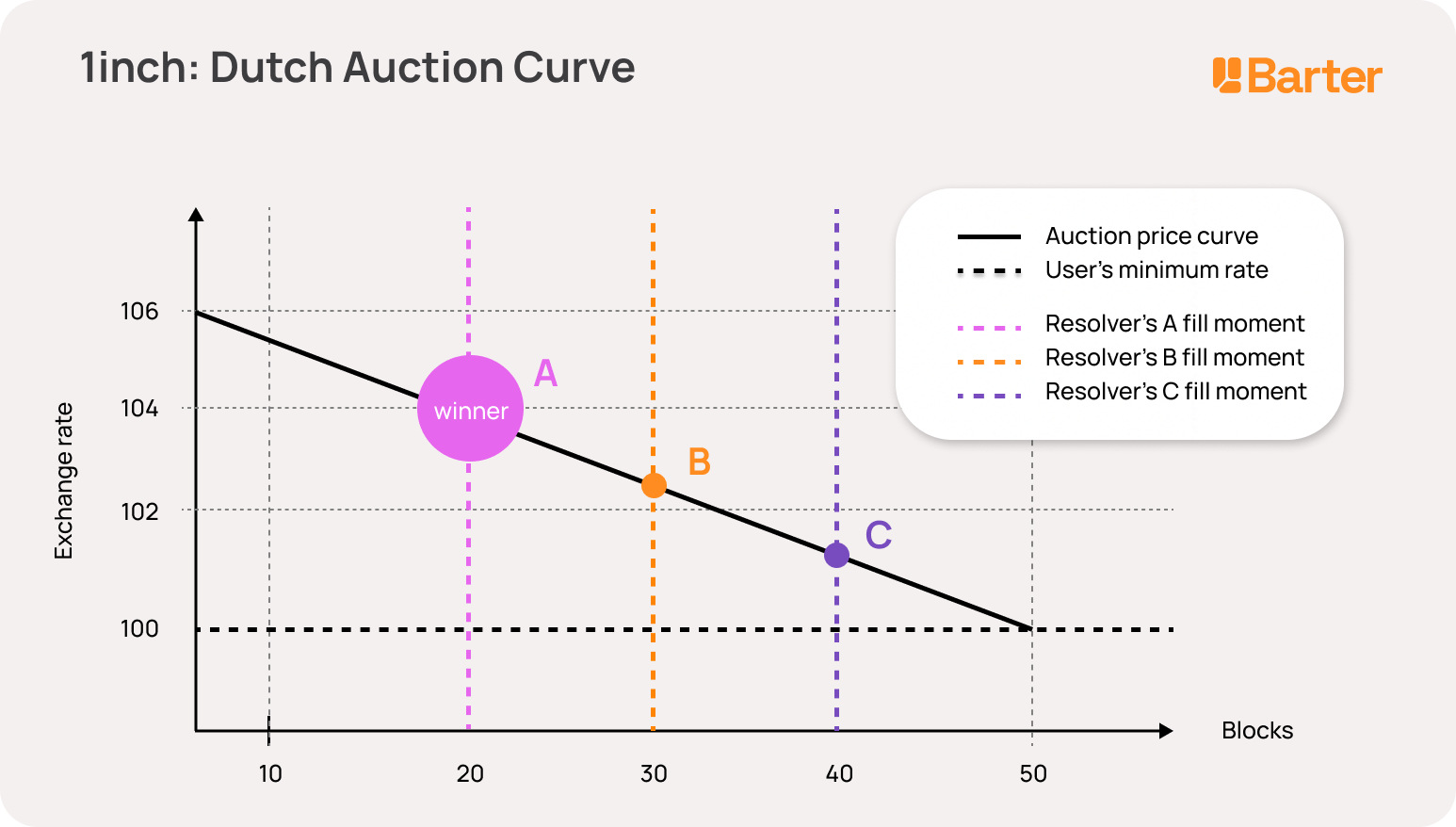
1inch has introduced intent-based swaps as part of its vision for more efficient and competitive decentralized trading. This approach uses a Dutch auction system that makes execution dynamic and competitive. The key idea is similar to Uniswap X: the user defines their minimum acceptable rate, and the protocol sets a starting rate that is typically more favorable than the market price. From there, a decay function gradually lowers the rate toward the user’s minimum.
Competition plays out in real time. For example, consider three resolvers competing in the same order. Resolver A fills early at a higher rate, accepting a smaller margin but guaranteeing execution. Resolver B waits for the curve to decay further, hoping to capture a larger profit, but loses the order because Resolver A acted first. Resolver C waits even longer but never has a chance, since the order is already completed. The outcome demonstrates the balance between profit and execution speed that lies at the core of the 1inch intent-based auction.
Conclusion: The Role of Intent Auctions in DeFi
Intent-based auctions are redefining trade execution in DeFi. Instead of exposing swaps to MEV and failed transactions, protocols now run competitive marketplaces where solvers compete to deliver the best outcomes for users.
Each system takes its own approach: CowSwap optimizes fairness through combinatorial auctions, Velora focuses on reliability, Bebop JAM brings speed and solver autonomy, UniswapX blends RFQ guarantees with Dutch auctions, and 1inch rewards fast execution through a clean Dutch curve.
As these models mature, intent auctions are set to become DeFi’s default execution layer. For users, that means cheaper, safer and more predictable swaps, setting the stage for the next generation of decentralized markets.
