

The Idle Liquidity Paradox
Content
The DeFi industry has normalised a contradiction. "Billions sit idle" is invoked to justify almost every new yield product, and the headline is large enough to take seriously: of roughly $150B in USDC and USDT on Ethereum today, approximately $75B sits in user wallets without earning yield. Yet the industry's answer is consistently the same — lock the capital up. Vault deposits, lending supply, concentrated LP positions, restaking: the token leaves the wallet, a wrapped claim takes its place, and the user transitions from holder to depositor.
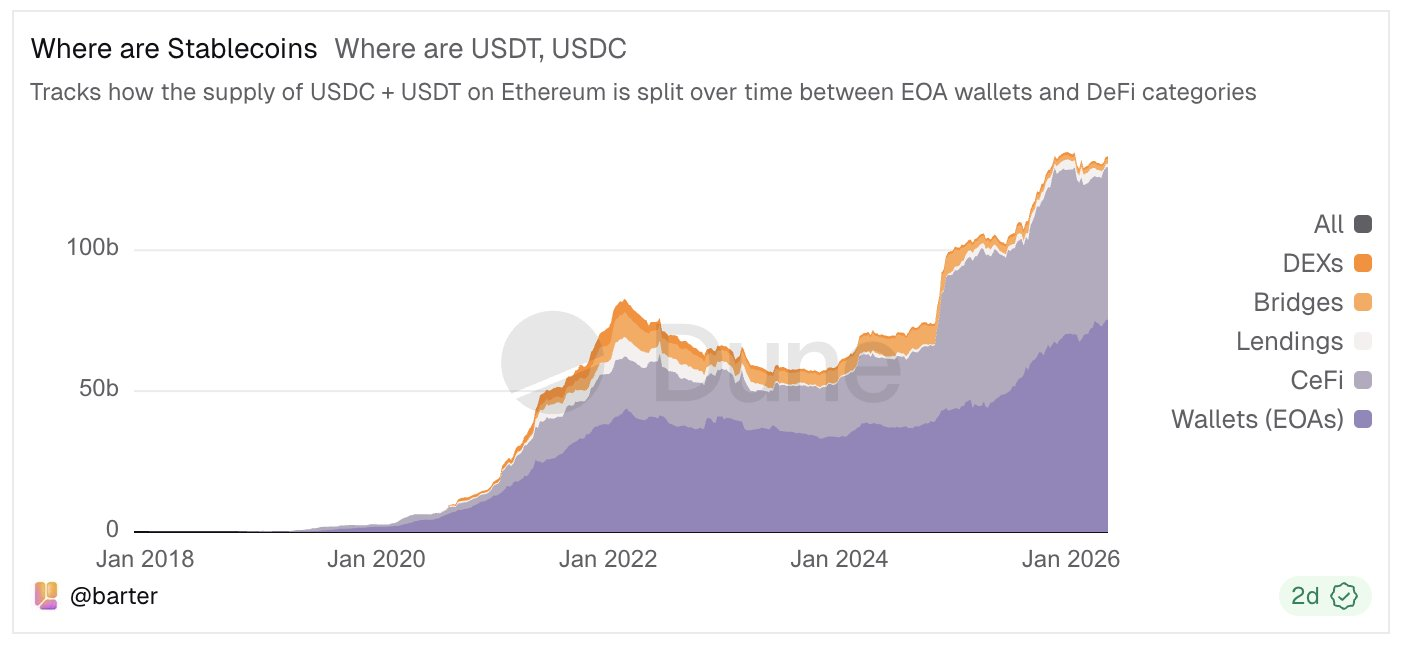
We use a deliberately narrow definition for the rest of this research:
Idle liquidity — tokens held in an EOA, smart wallet, or multisig with no participation in any on-chain DeFi position over the measurement window. Primary cut: 90 days. Secondary cuts: 30, 180, 365 days.
Quantifying Idle Liquidity
The goal of this part is to define who actually holds idle liquidity in stablecoins, which can be activated — and equally important, who does not.
Scope
- Network: Ethereum mainnet
- Assets: USDC and USDT
- Minimum balance: $1,000 per wallet
- Snapshot: 2026-04-24
The funnel walks the population of stablecoin holders through five sequential cuts, each removing a category that does not belong in any addressable analysis. The result is the Idle Capital Pool (ICP) — active DeFi users who hold meaningful idle stablecoin balances despite already engaging with on-chain finance.
Funnel Table
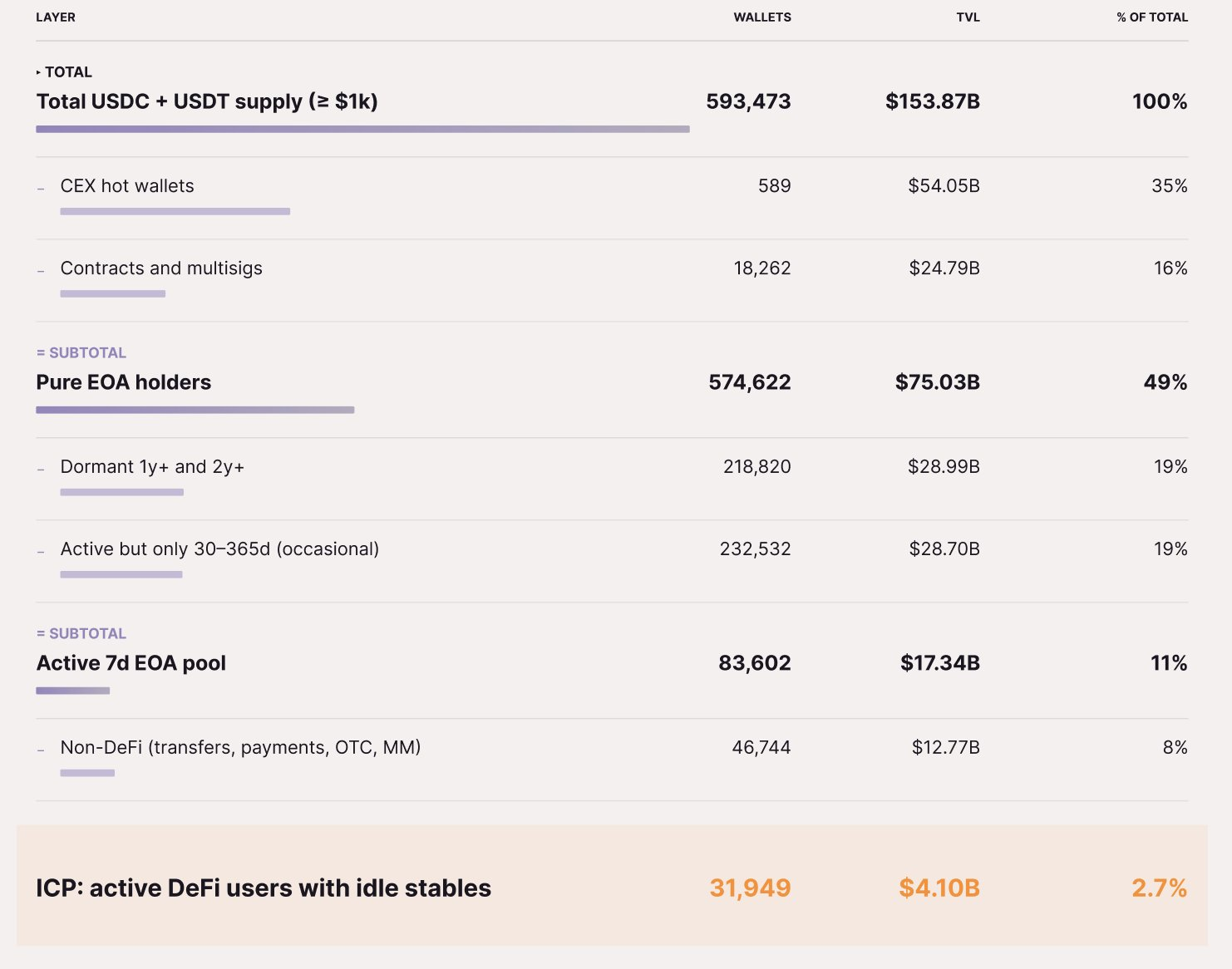 Source — dune.com/queries/7382063
The funnel collapses $153.87B of headline supply down to $4.10B — roughly 2.7% of where we started. Most of what is conventionally counted as idle stablecoin TVL is not idle in any operational sense, and most of the rest is unreachable.
Three findings worth pulling out
- 35% of stablecoin supply sits in 589 CEX hot wallets. Any idle-liquidity figure that fails to exclude this category overstates the addressable pool by orders of magnitude.
- $22.6B sits in wallets dormant for two years or more. Graveyard capital — keys lost, owners unreachable, deliberate disengagement. No activation model reaches it.
- 76% of "active" stablecoin capital never touches DeFi. Of the $16.87B held by regularly transacting wallets, $12.77B does payments, OTC, market-maker rotation and CEX flow without interacting with any DeFi protocol. The gap between "active" and "DeFi-active" is not an edge case, it is the bulk of the picture.
Who They Are: Composition of the Addressable Cohort
Yet $4.10B is still substantial, held by users who already understand DeFi. The standard explanation — that these users are passive or unaware of yield options — does not fit the data: by construction, every wallet has interacted with a DEX, an aggregator, or a yield-bearing token in the past year. They keep idle balances anyway. The rest of this research argues that the explanation is structural rather than informational.
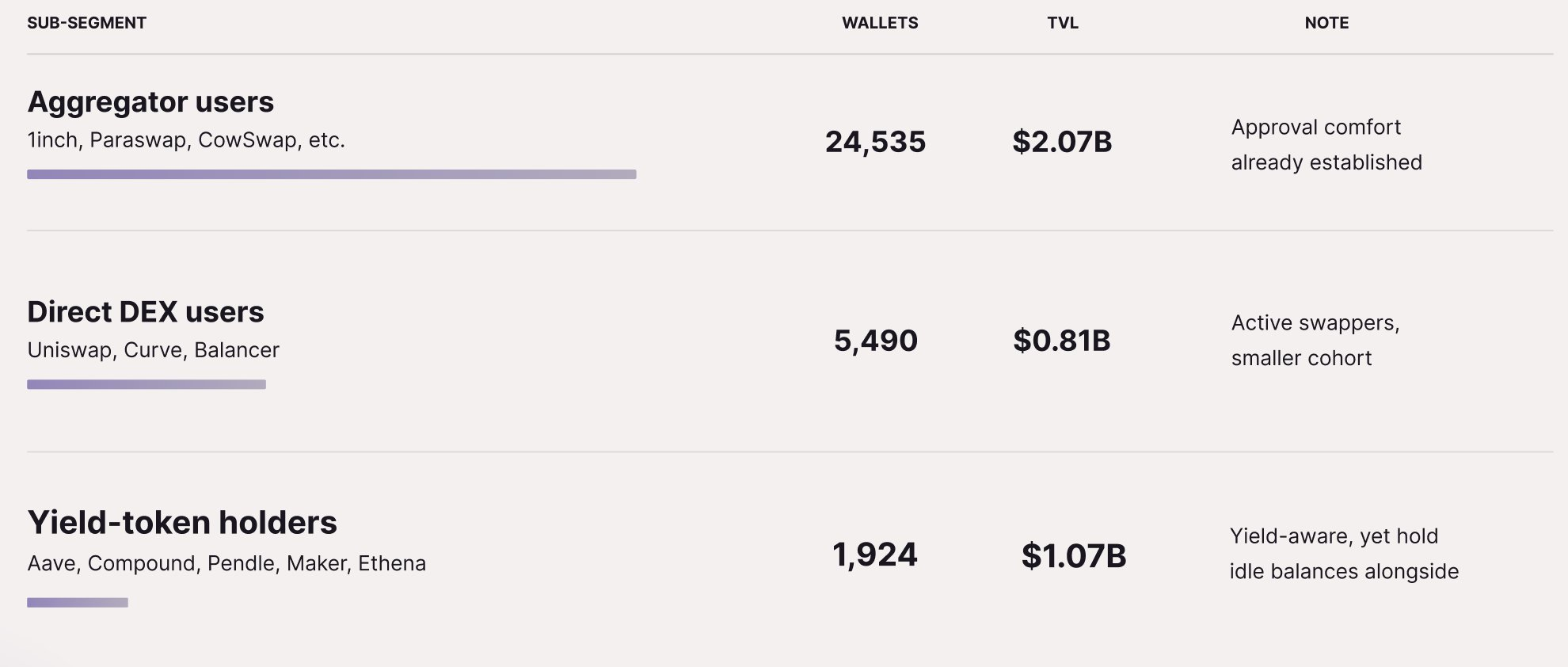 Source — dune.com/queries/7382152
Aggregator users dominate by wallet count — 77% of the cohort, roughly half the TVL. Their habit of signing approvals to routing contracts means the approval-based UX pattern is already familiar.
Yield-token holders are the most behaviourally interesting slice. They already hold aTokens, cTokens, sUSDe — they have made a deposit, accepted the wrapped-token model, and are actively earning yield on part of their balance. Yet they keep an additional $1.07B in idle stablecoins in the same wallets. They are not unaware of yield. They have already opted into it elsewhere. The persistence of an idle balance alongside a deposited one is direct evidence that the choice to remain idle is not driven by ignorance.
Two questions follow: what is the idle balance costing them, and what are they doing instead of depositing it.
What This Idle Capital Costs in Unearned Yield
The Opportunity Cost Index measures cost directly: for each wallet, average daily idle balance over a 180-day rolling window × per-asset benchmark Aave v3 supply rate (3.69% USDC, 3.50% USDT, 365-day rolling averages). Scaled to one year, the product is the foregone yield — what each wallet would have earned at the lending floor without changing its risk profile.
Across the cohort, the answer is $169.9M in foregone yield over the past twelve months at one of the most conservative benchmarks in DeFi.
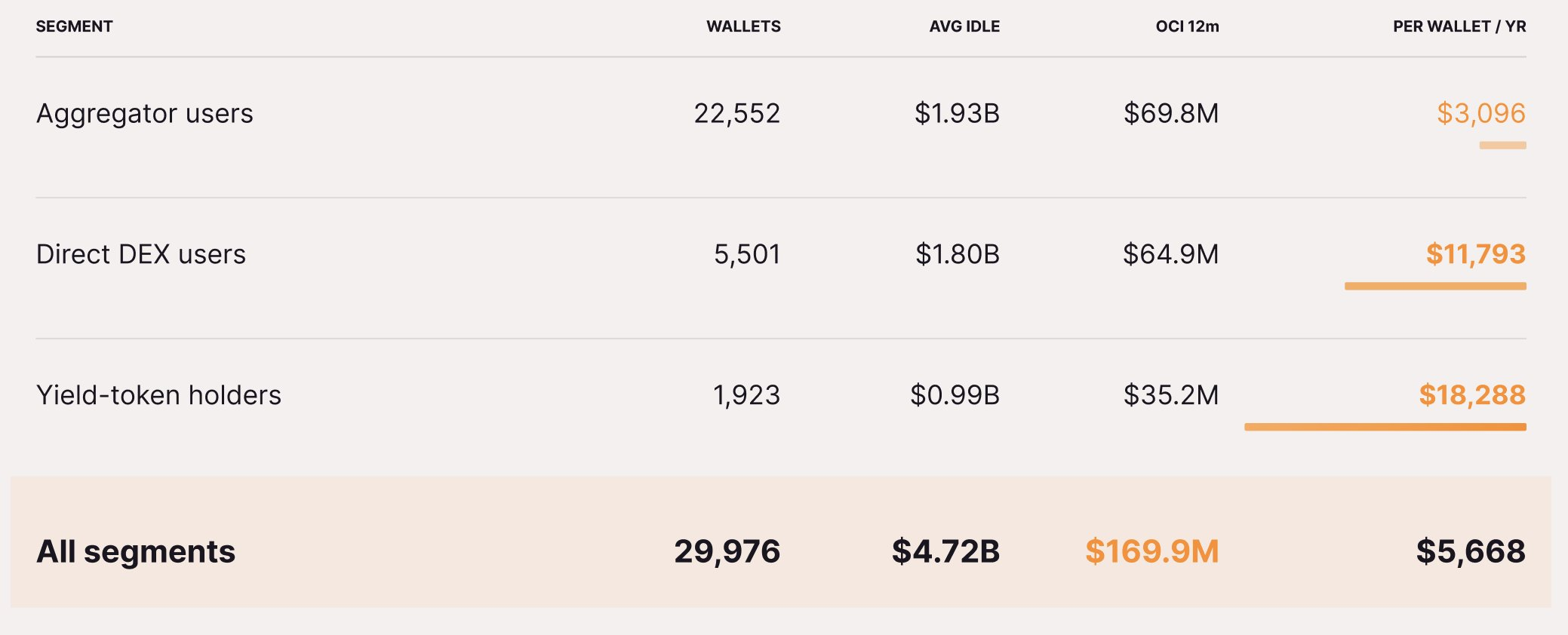 Source — dune.com/queries/7373152
They know how to make a stablecoin earn yield, and they choose to leave $18,000 a year per wallet on the table anyway. If the explanation were ignorance, the most yield-aware segment would be the first to deploy. They are not. Whatever is causing this is not an information gap.
Check your own Idle Liquidity and Opportunity Cost Index — https://dune.com/queries/7382471/11315695
What They Do: Behavioural Classification of Activity
To understand routine, we classified every outbound transaction the cohort initiated over a 90-day window into eight categories. Each transaction's address was matched against a custom dictionary of 510k+ classified addresses.
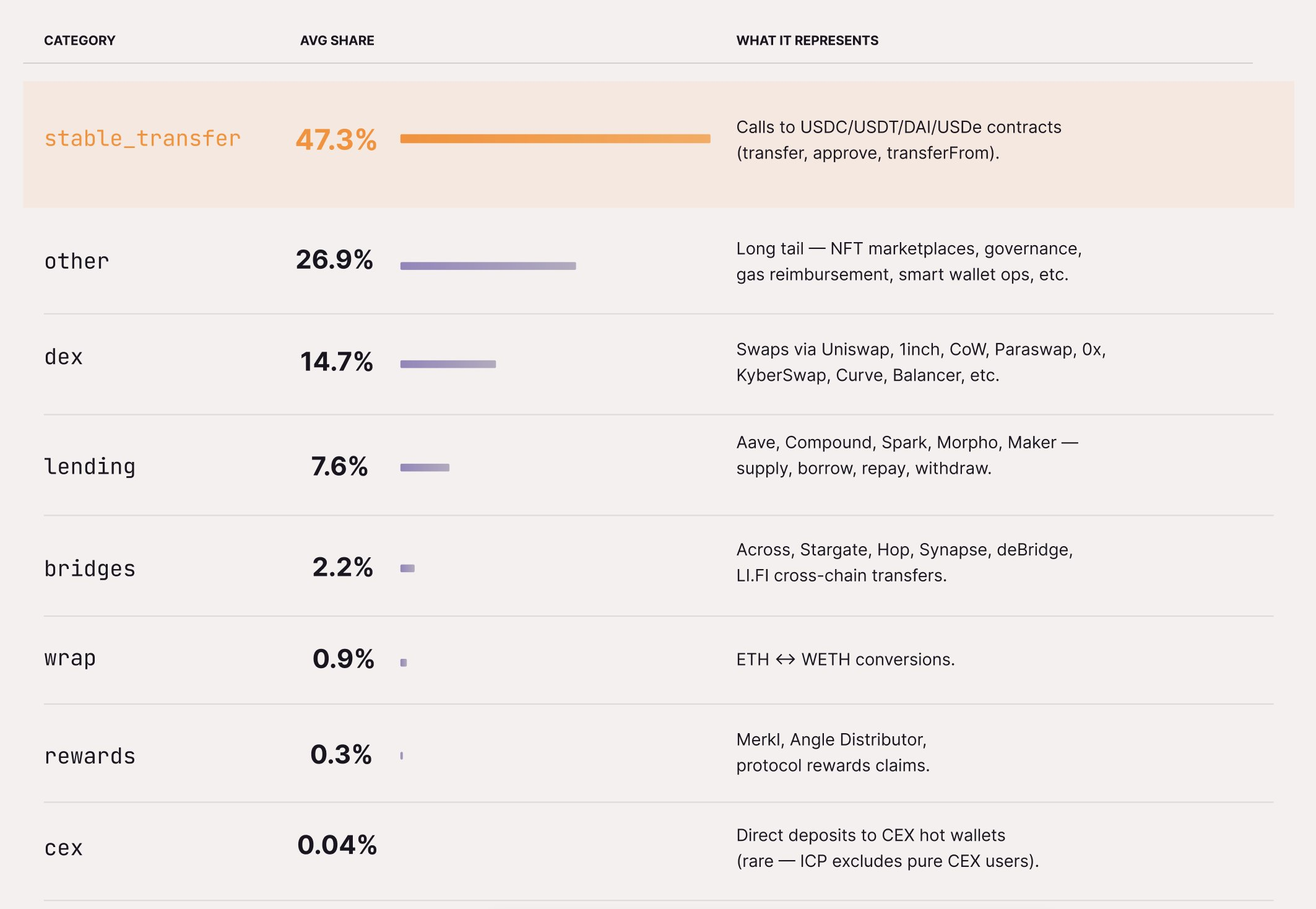 Source — dune.com/queries/7382332
Nearly half of all activity is moving stables. DEX activity comes second at 14.7%, lending at 7.6%, and the categories most associated with "DeFi participation" — DEX, lending, bridging — together account for less than a quarter. It is the activity profile of people running stablecoins as operational money.
Inside the 47%: What Stablecoin Movement Actually Is
The stable_transfer category is large enough to be worth opening up. Each transaction in it is a call to a stablecoin contract, but the calls are not all the same kind of action. We re-classified each one by its method selector — the first four bytes of calldata, which identify which function is being invoked.
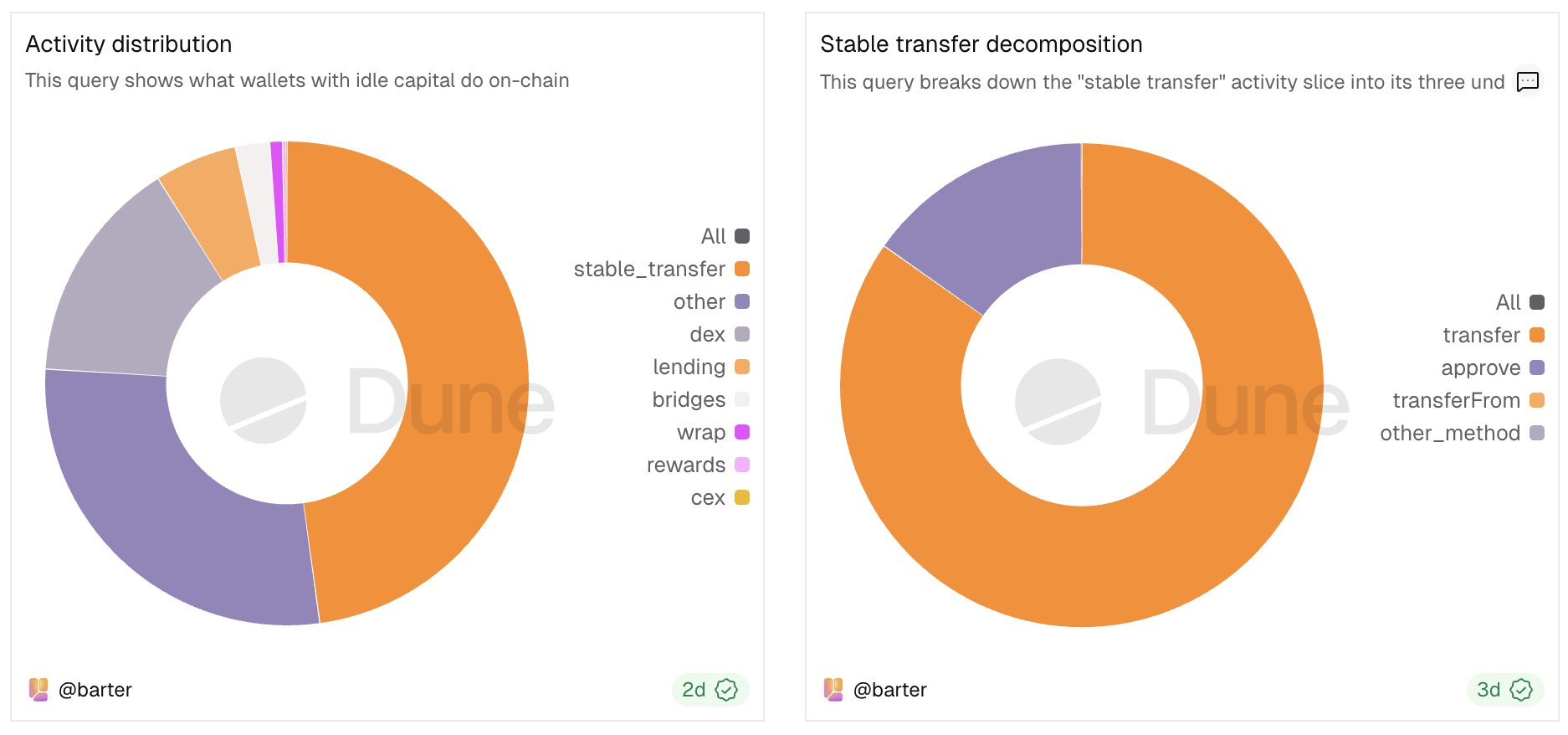
The bulk is real movement. 84.7% are direct transfers of stablecoins to another address, which means the cohort uses stables as operational money, not as a yield-bearing position waiting to be deployed. But 15% of the entire 47% is approval activity. The fact that this is already routine is the first concrete evidence that approve-based activation is operationally compatible with how the cohort already works.
The cohort holds $4.10B of idle stablecoin balance and forgoes $169.9M a year. They know about DeFi — every wallet has interacted with it. They use stablecoins as operational money — 47% of activity is moving stables, only 22% is DeFi engagement. Idle balances do not persist because users forgot about yield. They persist because the wallets are running flow, and flow cannot be deposited without breaking the flow. The cause of the opportunity cost is structural, not informational. The rest of this research takes that gap as given and examines what it looks like to fill it.
Where Existing Models Sit
The question now is which activation models, if any, fit the operational profile we just measured. We score the major ones on five axes: custody (where the token sits while earning), exit friction (how fast the position can be unwound), composability (whether the underlying remains usable elsewhere), and yield source.
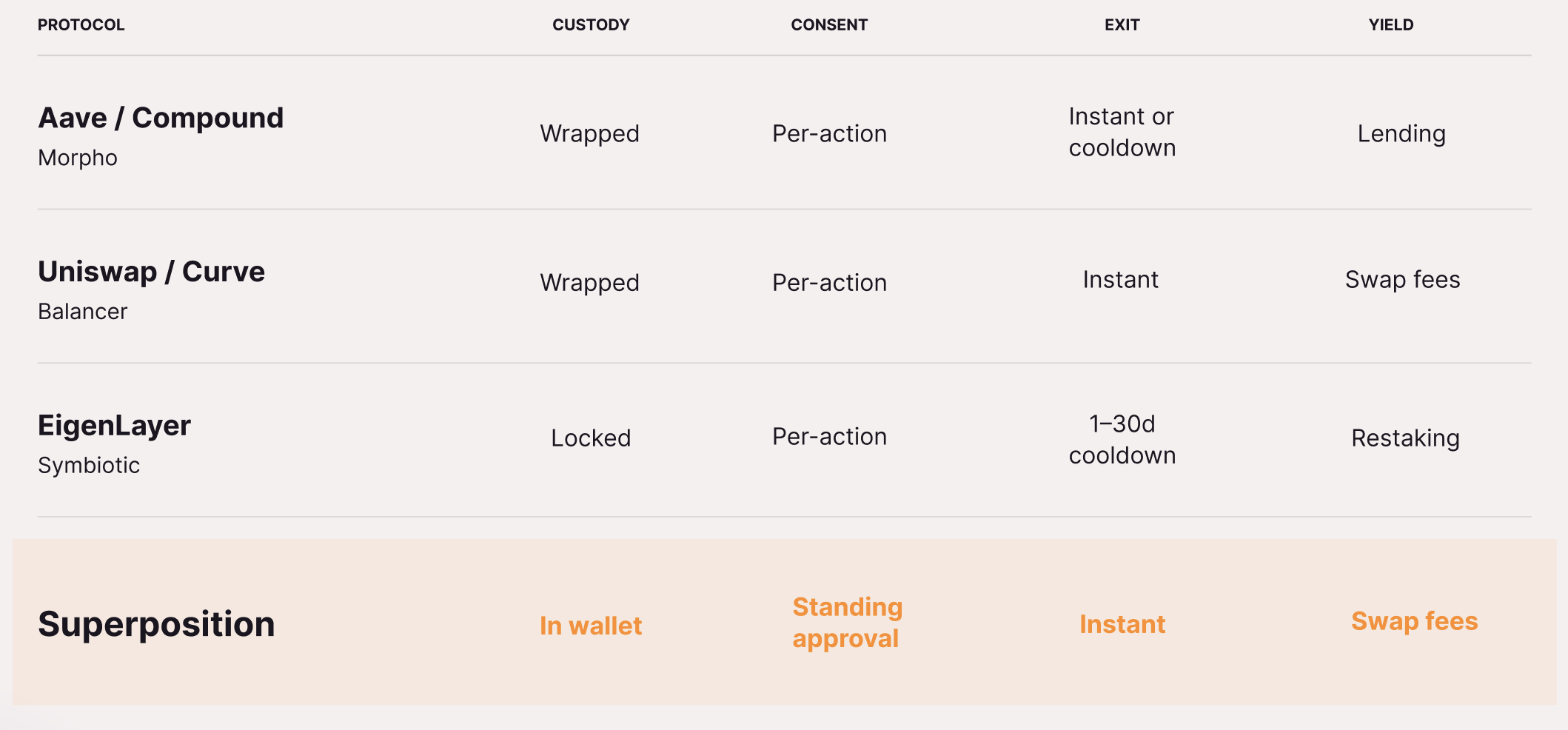 Activation protocols comparison
Three observations follow:
- First, every yield-generating cluster except wallet-permissioned requires custody change. The token leaves the wallet for a wrapped or locked position. This is a convention inherited from the AMM-derived design path, not a requirement of yield generation itself.
- Second, the operational cohort cannot tolerate this convention without friction. With 47% of activity being real stablecoin flow, any model that requires committing balance to a wrapped position imposes an unwrap-and-redeposit cost on the next transfer.
- Third, wallet-permissioned is the only architecture that preserves the operational pattern. Capital remains spendable while earning. Commitment is per-approval, not per-deposit. Revocation is instant.
The cohort's behaviour and the wallet-permissioned architecture are the only structurally compatible pair. The next part examines Superposition, the implementation built specifically for this fit.
How Superposition Works
Superposition replaces the deposit-based LP model with an approval-based architecture: assets never leave the user's wallet. Instead of depositing tokens into a pool, users grant a persistent ERC-20 approval to the protocol's contract. The system is therefore non-custodial by design — it controls allowances, not balances.
Assets remain fully transferable at all times. If tokens are moved or spent, they automatically become unavailable for routing until replenished. Liquidity is only utilized at the exact moment of execution — within a single transaction window — after which funds are immediately returned.
The key implication: yield generation does not interfere with the primary use case of the asset. That separation — between ownership and utilization — is the core design primitive Superposition introduces.
When a swap intent is routed through Barter's aggregator (integrated with venues such as CoW Swap, Velora, Matcha, or Uniswap X), the backend identifies eligible LP wallets — those holding the required asset. It then computes an optimal routing split across these wallets and returns a signed quote.
Once validated, the contract pulls tokens from selected LP wallets, executes the swap, and returns funds within the same transaction. Fees are retained directly in each LP wallet at the moment of execution (there are no LP tokens, vault shares, epochs or claim mechanics). Yield accrues instantly and remains fully liquid.
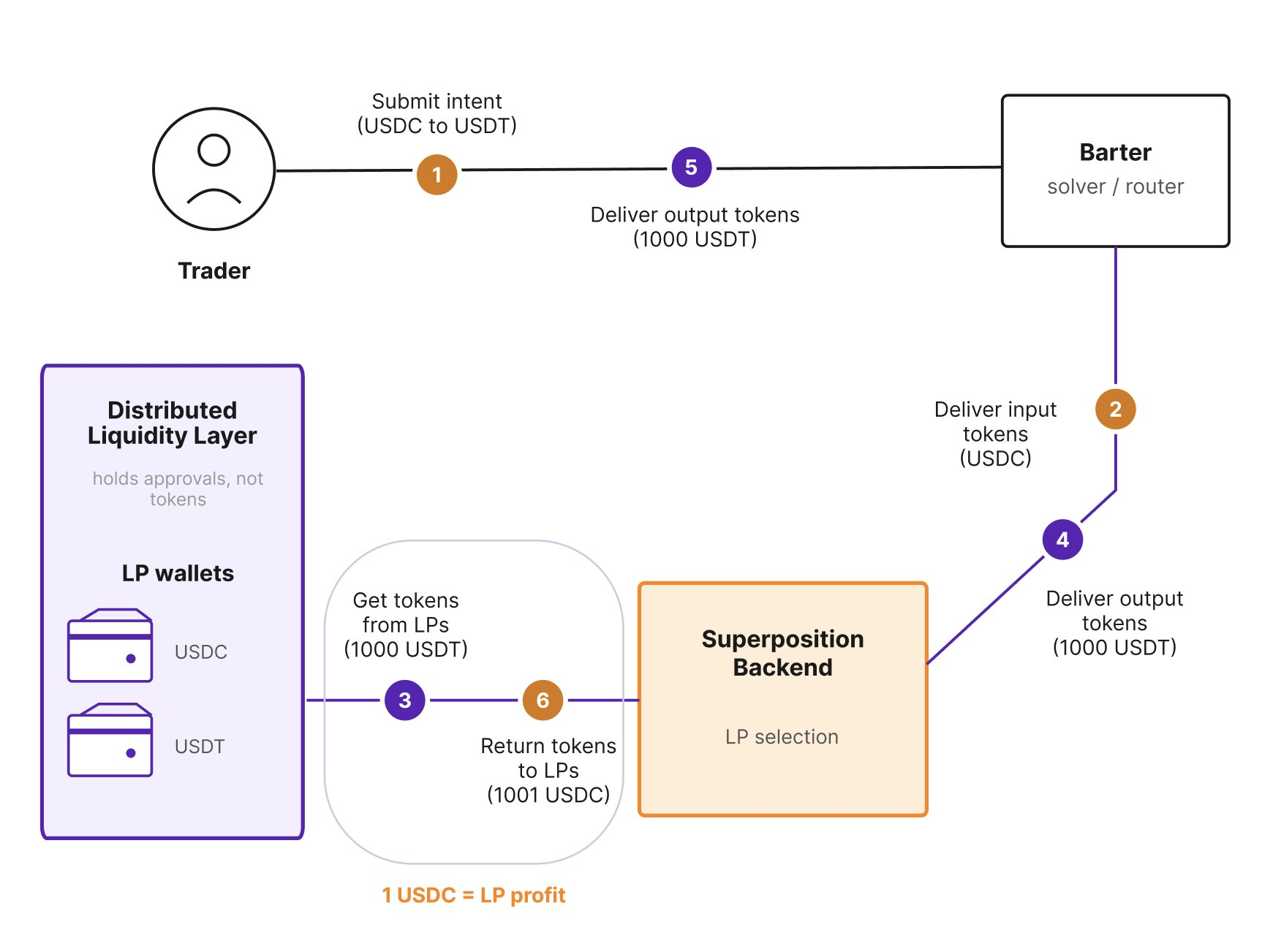 Superposition diagram
In V2, this quote is no longer trusted blindly. It is validated on-chain against an oracle price guardrail before execution. If the execution price deviates beyond acceptable bounds, the transaction reverts. This introduces a hard constraint against:
- abnormal execution prices
- manipulation attempts
- unexpected routing outcomes
Conclusion
There is $4.10B of stablecoin liquidity held by 31,949 active DeFi users on Ethereum mainnet, foregoing an estimated $169.9M a year in benchmark yield. They are not unaware of DeFi — every wallet qualified by interacting with it. They are not passive — 47% of their activity is real stablecoin movement. The idle balance persists because the wallets are running operational flow, and every existing yield architecture requires breaking that flow as the price of activation.
Wallet-permissioned liquidity, of which Superposition is the most developed implementation, is the first architecture that does not require breaking it: capital stays in the wallet, yield accrues from routed swap flow at the moment of execution, and the deposit event has been eliminated entirely. A model that fits operational stablecoin holders without asking them to stop being operational — now exists.
Try Superposition: https://app.barterswap.xyz/liquidity
Check Dune dashboard: https://dune.com/barter/idle-liquidity
