Coincidence of Wants research
Content
Introduction & Key Findings
We have taken a close look at the 'Coincidence of Wants' concept in DeFi swaps. Analyzing 25 random blocks (19063173 - 19063198), we aimed to understand its effectiveness with the current trading volumes. Spoiler alert: it is feasible to save nearly $1.5 million in token value for end users daily! #DeFi
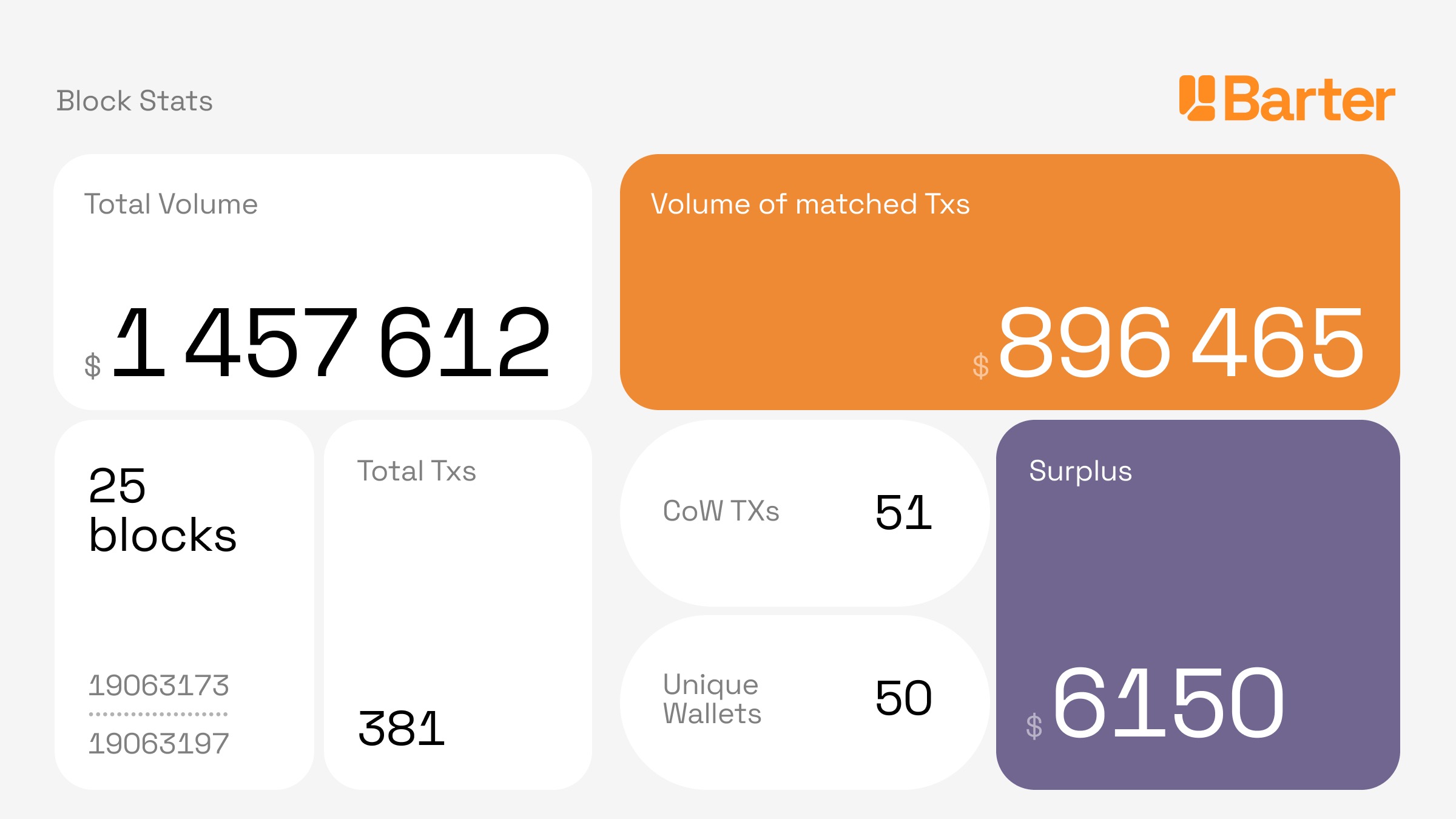
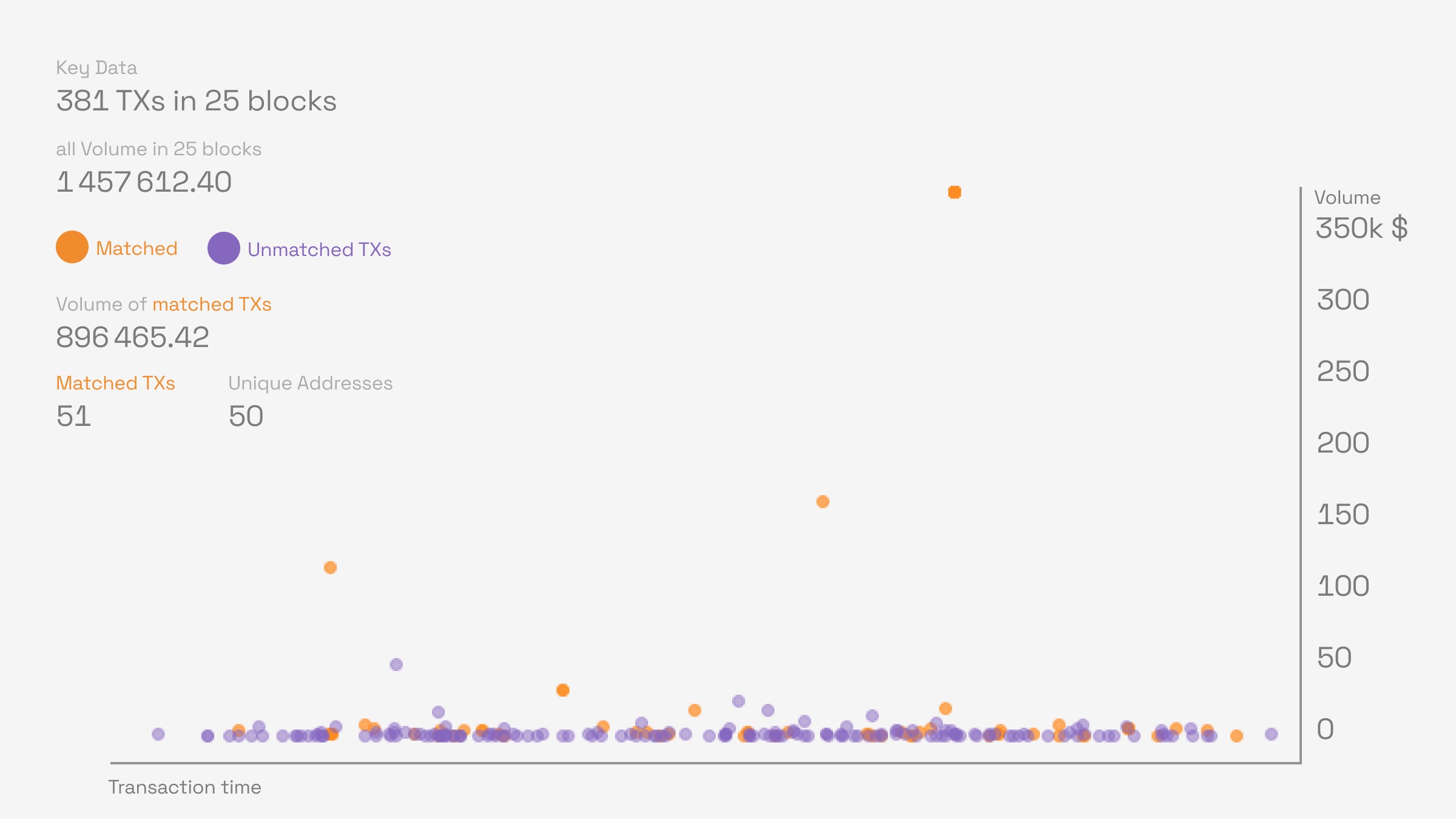
Key Data: trading volume during those blocks — 1,457,612 over 381 Txs. The total volume of matched txs is 896,465, The Surplus generated from performing CoW/Barter trades is 6150. The majority of the volume and surplus originated within 1 trading pair: ETH/USDT.
In our analysis, we scrutinized 381 transactions, primarily focusing on @Uniswap Routers, @MetaMask routers, and several aggregators. It's worth noting that this is a selective sample, primarily targeting key players in the space. Therefore, the actual number of transactions related to our topic might be even higher when considering the entire ecosystem. This selective approach was strategic, aiming to provide insights from significant market contributors
Transaction Volume & Matching Insights
Our analysis covers a diverse range of trading pairs, encompassing both niche Long Tail assets and popular choices like stables and mainstream tokens. The total number of pairs analyzed includes a mix of 13 different combinations, featuring pairs such as TITANX/ETH, RVF/ETH, and USDT/USDC, among others. This variety ensures a comprehensive overview of market dynamics across both high-volume and less common pairs, providing a well-rounded picture of the current trading landscape.y transforming DeFi, and Dapps will need to move in this direction or risk losing market share. We’re going to share our predictions for Intents in DeFi for 2025 soon, but before that, let’s take a look at how much the space has grown and how many projects are actively building here. This is the first iteration of our Map, so we’ll add more projects and possibly unbundle a few categories as we refine it. If we missed your team, please accept our apologies — reach out and we’ll be sure to add you in the next version!
In just 25 blocks, a span of approximately 5 minutes, our analysis shows that it's feasible to match 61.5% of the trading volume and 13.3% of transactions processed through routers. This efficiency resulted in a surplus of $6,150. Extrapolating these results to the entire day's 7,150 blocks, we could potentially save nearly $1.5 million in token value for end users daily. This estimation underscores the significant impact that efficient transaction matching can have on value savings in the DeFi space.
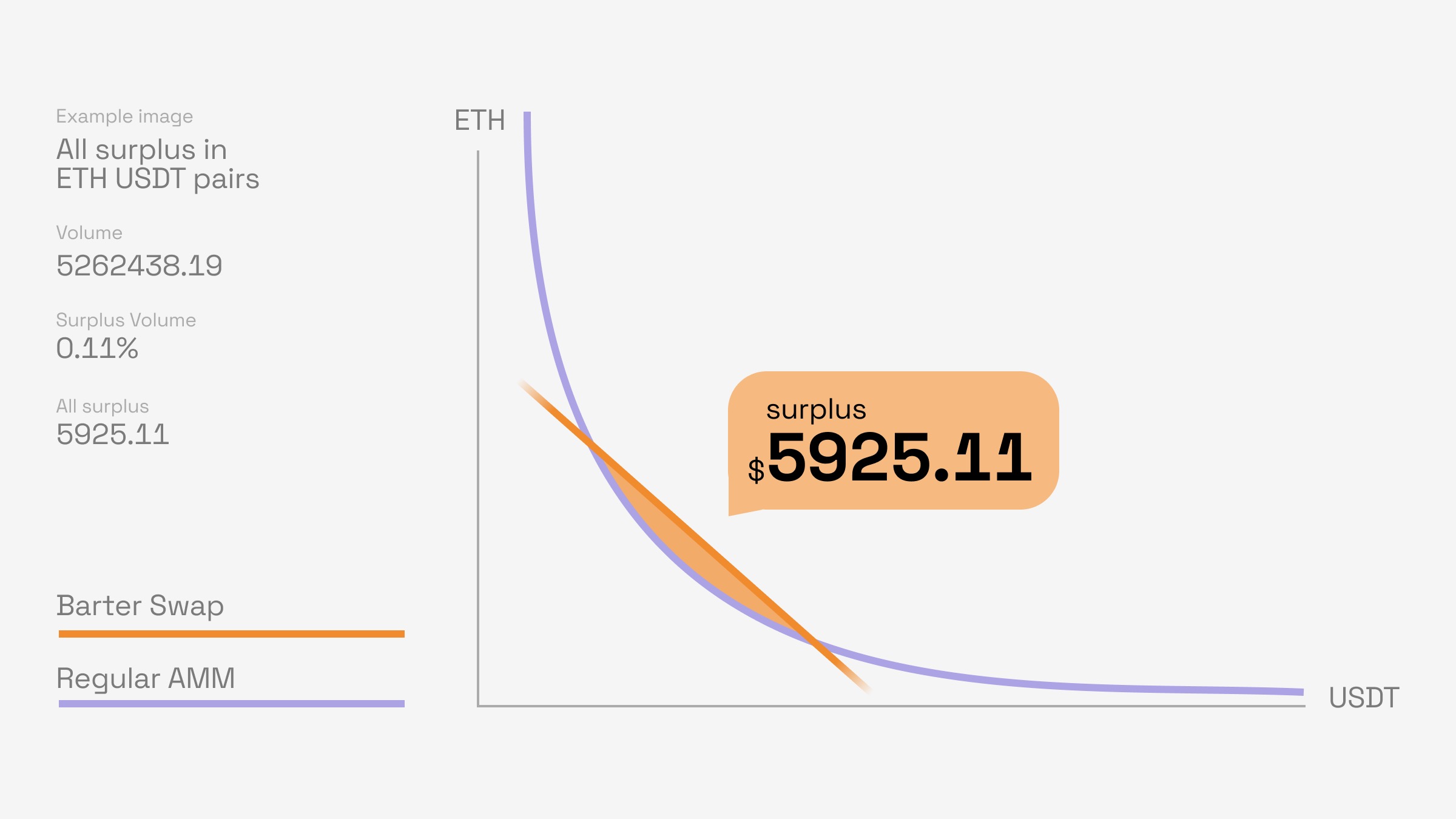
Our analysis revealed that the ETH-USDT pair was a significant contributor to the surplus, accounting for the majority of it. This trend isn't isolated; examining other blocks indicated that mainstream pairs often drive Double Coincidence of Wants, particularly in volatile market conditions. This suggests that high-liquidity pairs like ETH-USDT play a crucial role in optimizing transactional efficiency and surplus generation in the DeFi ecosystem
Efficiency Factors & Market Dynamics
In our analysis, we didn't account for the potential gas savings associated with RFQ transactions, which are notably more gas-efficient. The actual cost savings could be very significant. Notably, the average time between matched orders in our dataset was just under two minutes (approximately 1.97 minutes), underscoring the efficiency and rapidity of these transactions. This further highlights the potential for dramatic reductions in execution costs in DeFi trading.
Our data indicates that volatility is a key factor in СoW/Barter trading efficiency. During periods of high market volatility, we noticed an increased volume of orders in opposite directions. This situation creates ideal conditions for efficient matching, leading to potentially higher gains from trade execution. Understanding and leveraging this volatility factor can significantly enhance the effectiveness of order-matching strategies in fluctuating markets.
While CoW/Barter trades are powerful tools in the DeFi ecosystem, our team believes that relying on a single approach or liquidity source isn't sufficient to dominate the swap market. A more effective strategy would be to integrate on-chain liquidity with intent-based CoW/Barter trades. This approach is likely to yield the best outcomes for users, harmonizing their diverse needs and finding an equilibrium in the market that balances efficiency and accessibility.
Based on our Solver experience, on-chain liquidity is highly competitive across various of our integrations. We wanted to do a quick shoutout to brilliant innovators of the DeFi space: @Uniswap @Balancer @CurveFinance @hashflow @mavprotocol @native_fi @Clipper_DEX @IntegralHQ @ValantisLabs @fraxfinance @ambient_finance @KyberNetwork @Bancor and many others!
The Role of Intents & MEV Mitigation
Intents represent a form of liquidity that can be actively utilized. As more intents are generated through diverse Dapps, UIs, and Protocols, we observe an increasing fragmentation of on-chain liquidity. This growing fragmentation underscores the dynamic nature of the DeFi ecosystem, where liquidity sources are not static but are continuously shaped and reshaped by community
Utilizing the concept of coincidence of wants across various protocols presents a significant opportunity to mitigate Miner Extractable Value (MEV) risks, especially for retail users. This strategy is particularly beneficial for larger orders, which inherently carry a higher risk of MEV exposure.
Next Steps & Acknowledgements
Our team is poised to delve deeper into our research, exploring key questions to refine our understanding of DeFi trading behaviors. We aim to determine the extent of users' patience: specifically, how long are they willing to wait for slight price improvements? Additionally, we plan to investigate the efficiency of Barter/CoW trades in different market segments. Are these trades more effective for long-tail assets or for blue-chip tokens? These insights will be crucial in shaping more user-centric trading strategies and optimizing market efficiency.
We're thrilled to share the first step of our research journey! This preliminary analysis confirms our core hypothesis, showcasing the immense potential for DeFi efficiency improvement through CoW/Barter trades. Stay tuned as we delve deeper into our findings and work towards enhancing DeFi's efficiency.
We extend our heartfelt thanks to the @CoWSwap team for their invaluable support throughout our journey. Collaborating with your platform over the past 10 months has been a remarkable and enriching experience. Thank you for being an integral part of our story 💙