

Barter x 1inch
Content
Introduction
At Barter, we’ve spent years building infrastructure to optimize token swaps across intent-based protocols like CoWSwap, Bebop or Velora delta, where our solver has already processed over $18,5 billion in trading volume. Now, we are expanding our role by becoming an official resolver for 1inch intent-based swaps, making Barter present on all major intent-based DEXs on Ethereum Mainnet.
1inch’s intent-based swap runs on a whitelist of resolvers selected through Unicorn Power (UP) delegation, where users express their intent and resolvers compete in a Dutch auction to execute it. Instead of thousands of actors competing in open mempools, execution is concentrated in the hands of a few highly capitalized players.
In this case study, we explore how 1inch intent-based swaps work today: execution dynamics, the economics of resolver competition, and the governance framework of UP – and share what it means for Barter to join this exclusive set of resolvers.
General analytics of 1inch intent-based swaps
By mid-2025, 1inch intent-based swaps had processed more than $40 billion in total trading volume. 1inch has oscillated between $1-2.5B per month, with clear cyclical peaks. For instance, late 2023 and late 2024 show strong surges, coinciding with periods of heightened market activity across Ethereum. The protocol attracts around 30K–60K unique wallets per month, with spikes above 80K during market upswings. Monthly order count has stayed in the 80K-150K range. The volume/order ratio is the clearest indicator: while order numbers are not exploding, volumes per order are.
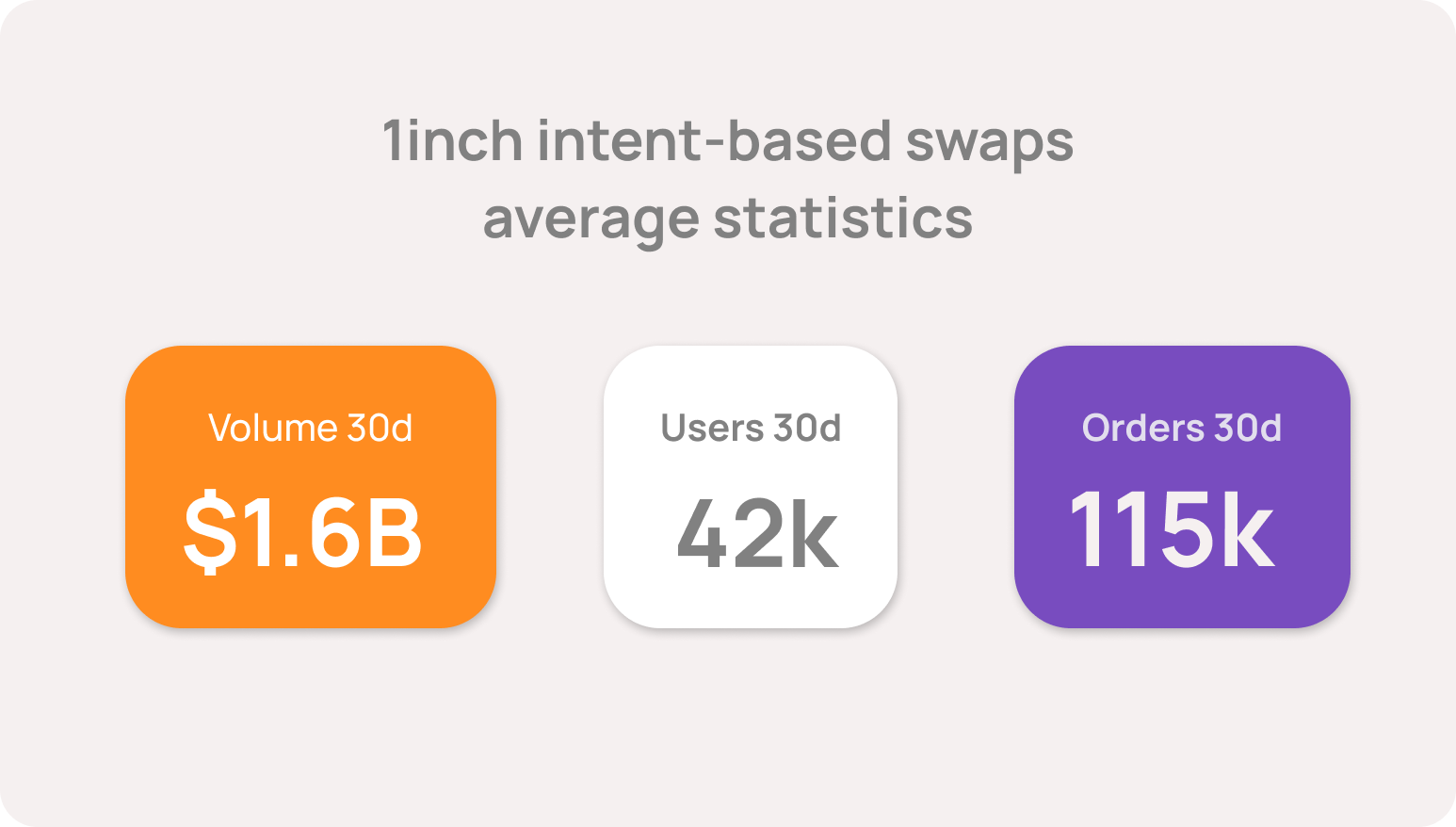
Unlike classical swaps, where activity scales linearly with retail adoption, intent-based swaps evolve in bursts, tied to the behavior of large players and positioned as a premium execution layer: fewer trades, fewer users, but significantly higher value per transaction. This pattern is consistent with the broader logic of intent-based protocols: by outsourcing execution to specialized resolvers, the system naturally favors whales, professional traders, and arbitrageurs who can maximize the benefits of block-by-block Dutch auction pricing. Retail users, although present, are a minor user group.
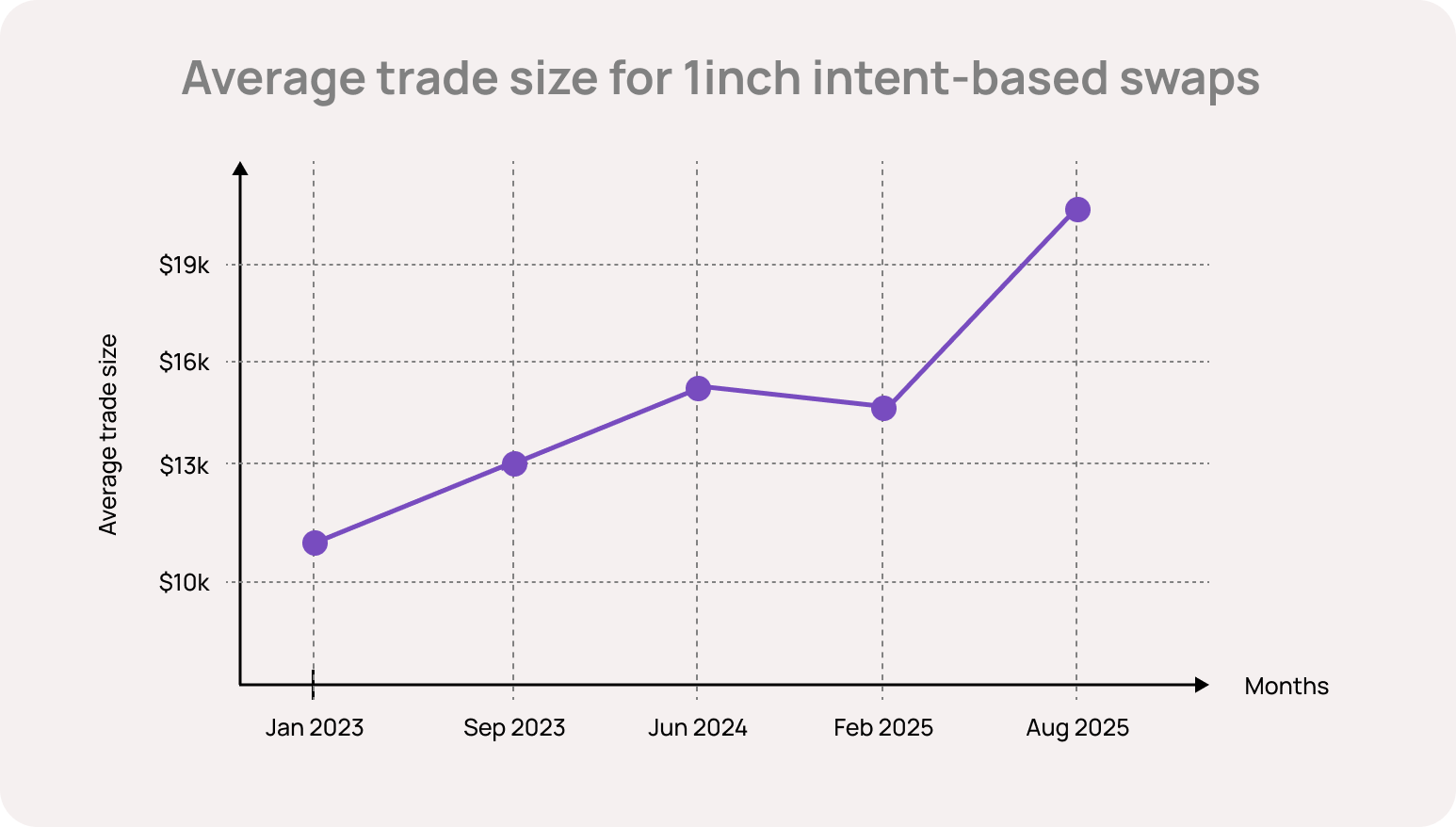
From January 2023 through August 2025, the average trade size on 1inch intent-based swaps ranged between $11K and $16K per order, with occasional spikes above $20K (notably in August 2025). When aggregated over the full period, average order size settles at roughly $14K per trade.
The average trade size for intent-based swaps was derived by dividing the monthly trading volume by the number of executed orders in the same period. For earlier months, approximate values of monthly volume and order count were taken from the Dune dashboards, allowing us to estimate historical averages and illustrate the upward trend.
1inch Classic Swap, on the other hand, has remained remarkably stable. Across the same time window, average trades fell in the narrow band of $1.6K - $1.8K per order. This consistency reflects Swap’s role as a retail-heavy, high-frequency environment, where millions of small orders drive volume.
Resolvers: Distribution of Power
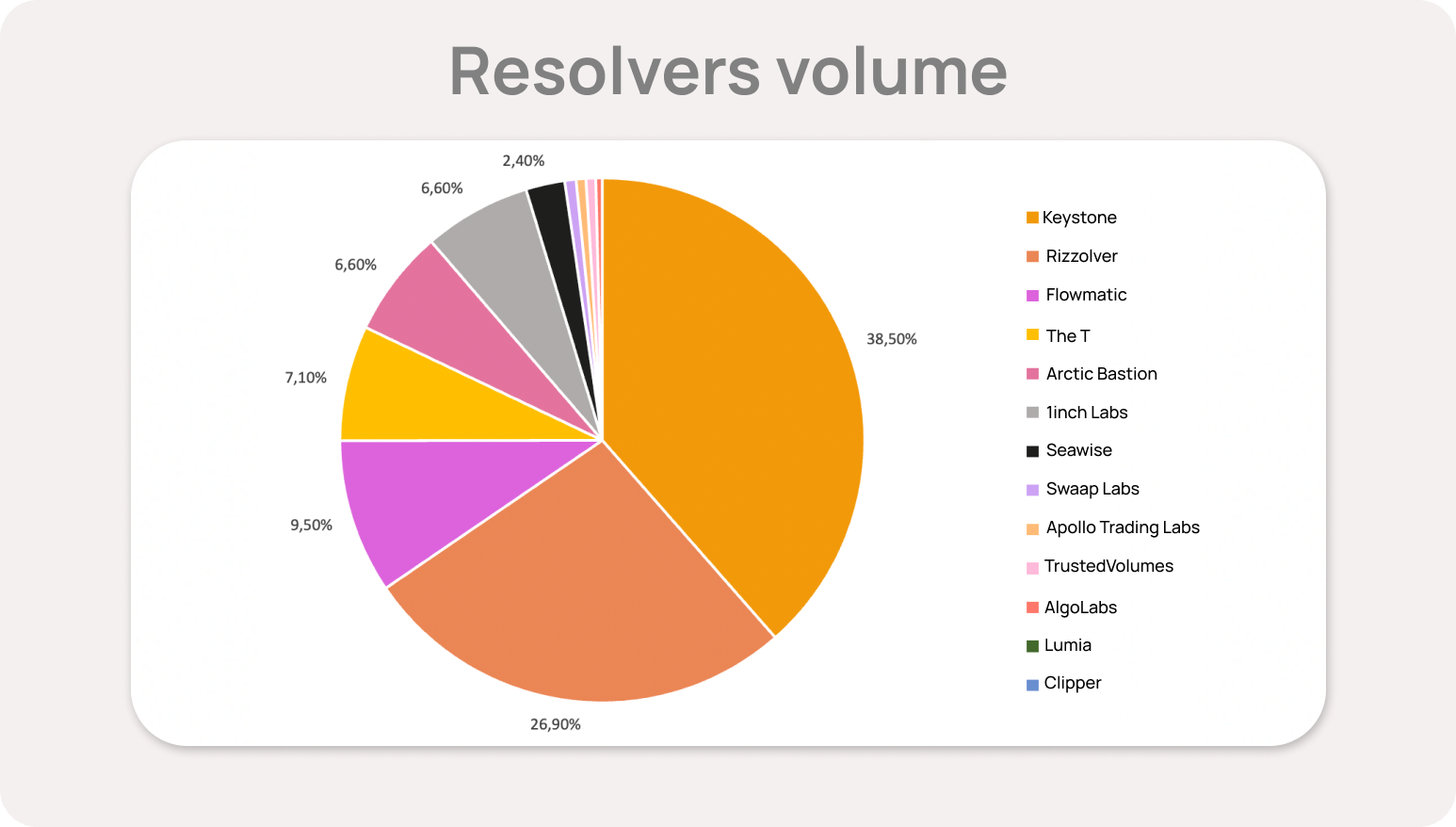
The competitive landscape among resolvers in 1inch’s intent-based swaps remains highly concentrated, with a handful of players dominating execution. In the last month, Keystone took the lead with $879 million settled, representing nearly 38.5% of total volume. Rizzolver followed with $615 million (26.9%), securing its position as the biggest executor.
Below them, volumes dropped significantly: Flowmatic ($218M), The T ($161M), Arctic Bastion ($152M), and 1inch Labs ($150M) each controlled between 6-10% of market share.
Together, these six resolvers accounted for almost 95% of all execution volume, leaving only a narrow slice for the long tail of smaller actors such as Seawise, Swaap Labs, Apollo Trading Labs, and TrustedVolumes, each below 3%.
Overall, the data underscores the highly concentrated nature of 1inch’s execution layer, where a handful of large resolvers effectively control order settlement.
Access Control: Unicorn Power and the Resolver Whitelist
1inch intent-based swaps’ execution layer is regulated by Unicorn Power (UP), a governance-derived metric based on staking and delegation of 1INCH tokens. This design filters resolvers by capital commitment and community trust, ensuring only qualified actors can handle intent-based swap orders.
UP is generated when users stake 1INCH tokens into the staking contract and receive st1INCH in return, the longer the lockup (from 1 month up to 2 years), the higher the UP multiplier. Holders of UP can delegate it to resolvers through delegation pods, allowing ordinary stakers to earn yield without having to operate infrastructure themselves. To qualify for the whitelist and become an active resolver, a candidate must control at least 5% of the total Unicorn Power (UP) in circulation and simultaneously rank among the top-10 UP holders.
Crucially, the delegation layer transforms UP into a marketplace for trust, performance, and incentives. Stakers allocate their UP not only on the basis of raw yield, but also by considering a resolver’s reputation, reliability, and track record in execution. In theory, this should align economic incentives: capital flows toward the most efficient and trustworthy resolvers, who then maintain their position in the whitelist. In practice, however, the picture is more nuanced.
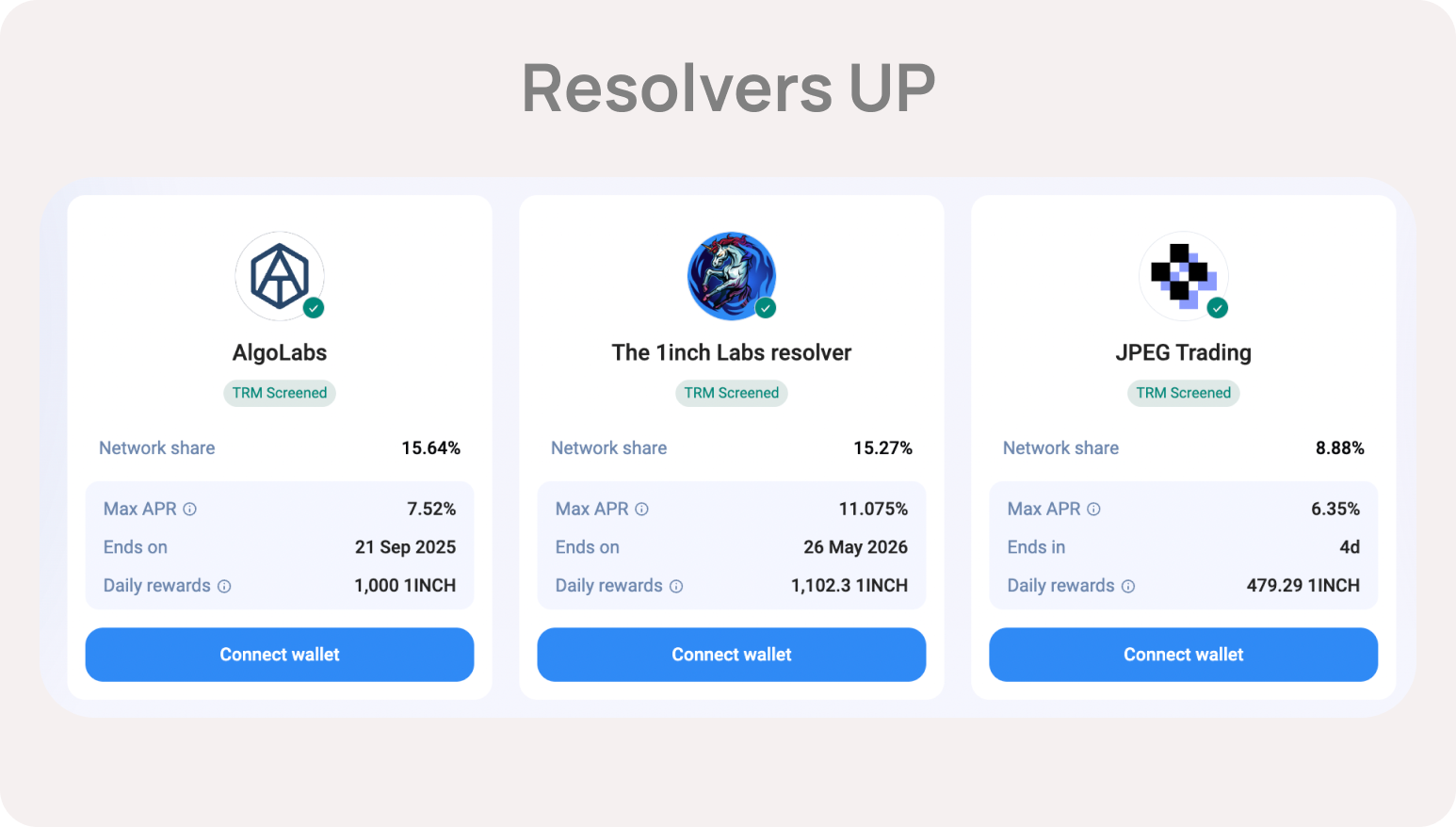
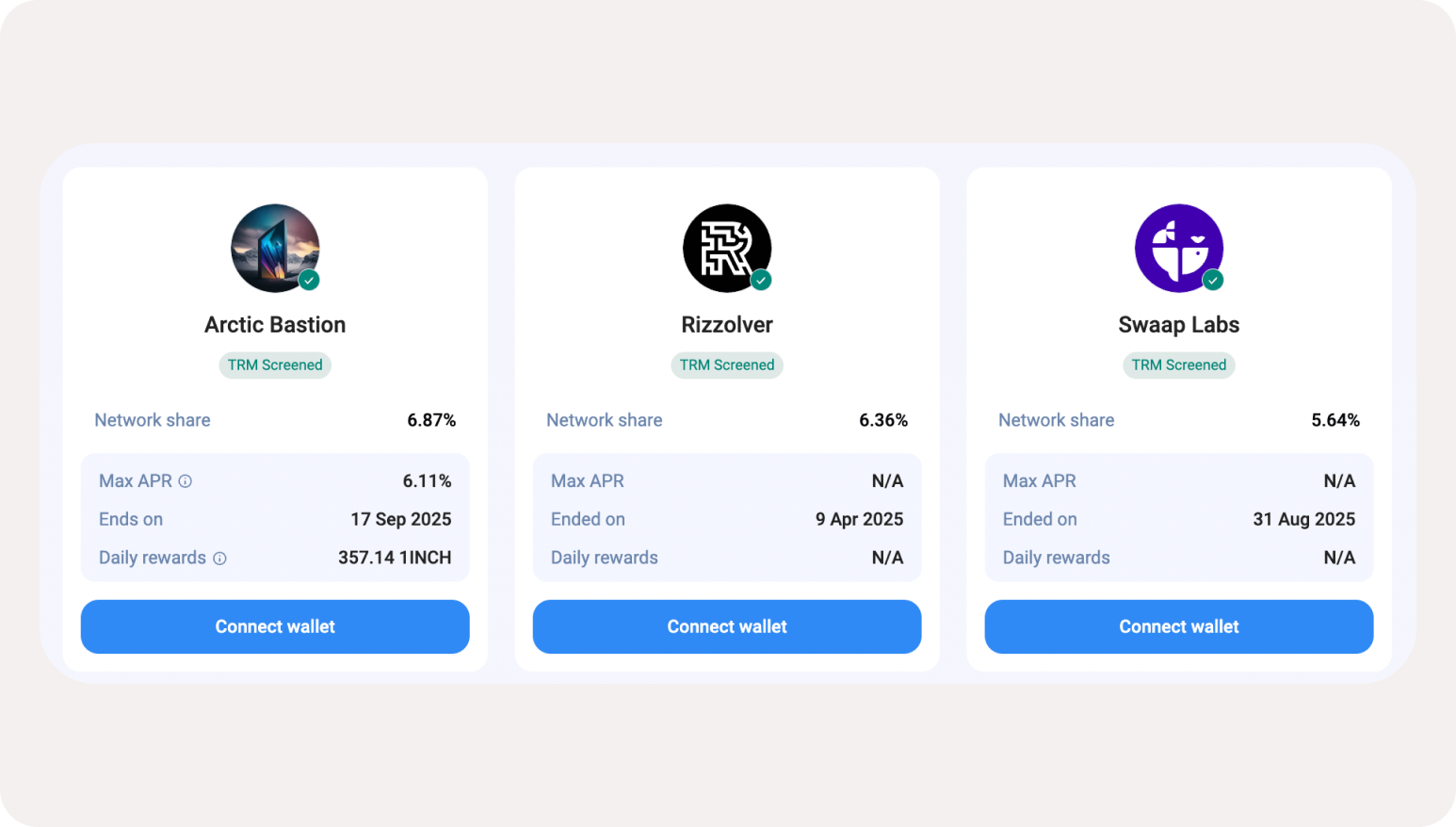
The staking dashboard shows the current UP distribution: leaders include AlgoLabs (15.6%), 1inch Labs Resolver (15.3%), JPEG Trading (8.9%), Arctic Bastion (6.9%), and Rizzolver (6.4%), followed by a cluster of entities around the 5% threshold such as Swaap Labs, Clipper, Seawise, Apollo Trading Labs, The T, Flowmatic, and Keystone.
1inch intent-based swaps’ access control creates a two-layer system: UP defines who is allowed to compete, but backend efficiency defines who actually wins orders. For Barter and other resolvers, this means success requires both community backing through delegation and operational excellence in execution infrastructure. Governance opens the door, but infrastructure decides who stays inside.
1inch auction
At the heart of 1inch’s intent-based swaps is a Dutch auction mechanism, it determines when and which resolver gets to fill a user’s order. Unlike a simple RFQ or constant-price order book, intent-based swaps introduce a time-dependent price curve that makes order execution competitive. Resolvers compete on latency, capital efficiency, and routing strategies. This shifts the value capture from extractive MEV bots toward structured competition among whitelisted resolvers.
When a user submits an intent-based swap order, the system sets up the auction curve:
- The user specifies their minimum acceptable rate (the worst price they are willing to accept).
- The protocol calculates a starting rate, typically better than the current market price.
- A decay function gradually decreases the rate from this starting point down toward the user’s minimum.
This curve defines the profit margin available to resolvers at any given block.
Resolvers monitor orders through the Intent Swap API and contracts. For Barter and others, the process is:
- Observe the auction curve: at each block, the rateBump shows how much premium is left above the user’s minimum.
- Estimate profitability: factoring in gas, hedging, and arbitrage opportunities.
- Decide when to fill: If the curve hasn’t decayed enough, profit is too thin, so resolvers wait. If the curve has decayed to where profit > costs, the resolver submits a transaction.
Because multiple resolvers compete, the one who reacts fastest and optimizes gas/latency typically captures the order.
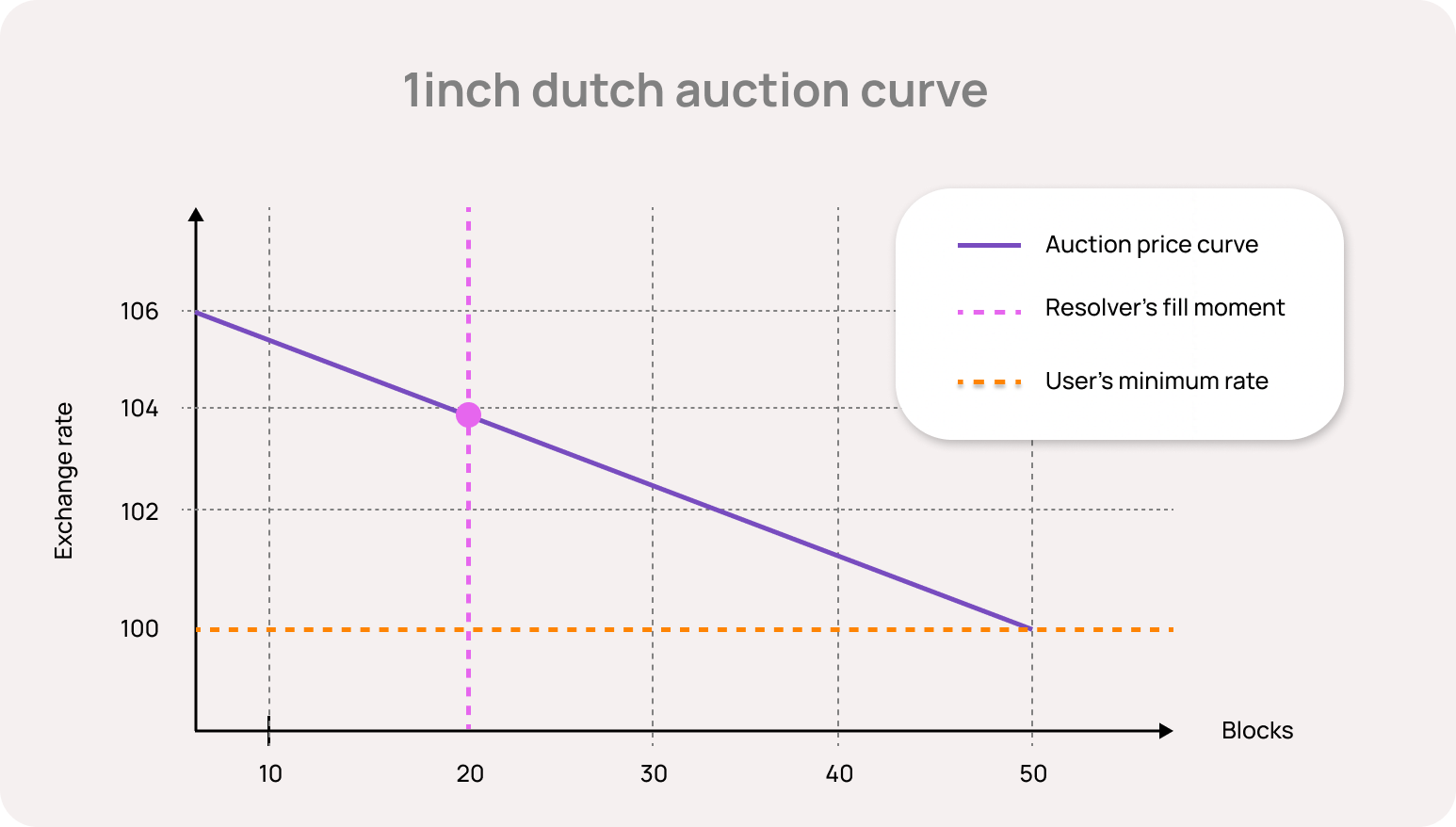
Here’s a visualization of the 1inch intent-based swap Dutch auction curve:
- The purple curve shows the price decaying from the starting rate (106) down to the minimum user rate (100).
- The orange dashed line marks the user’s worst acceptable price.
- The pink line and dot show where a resolver decided to fill (at block 20, price ≈ 104).
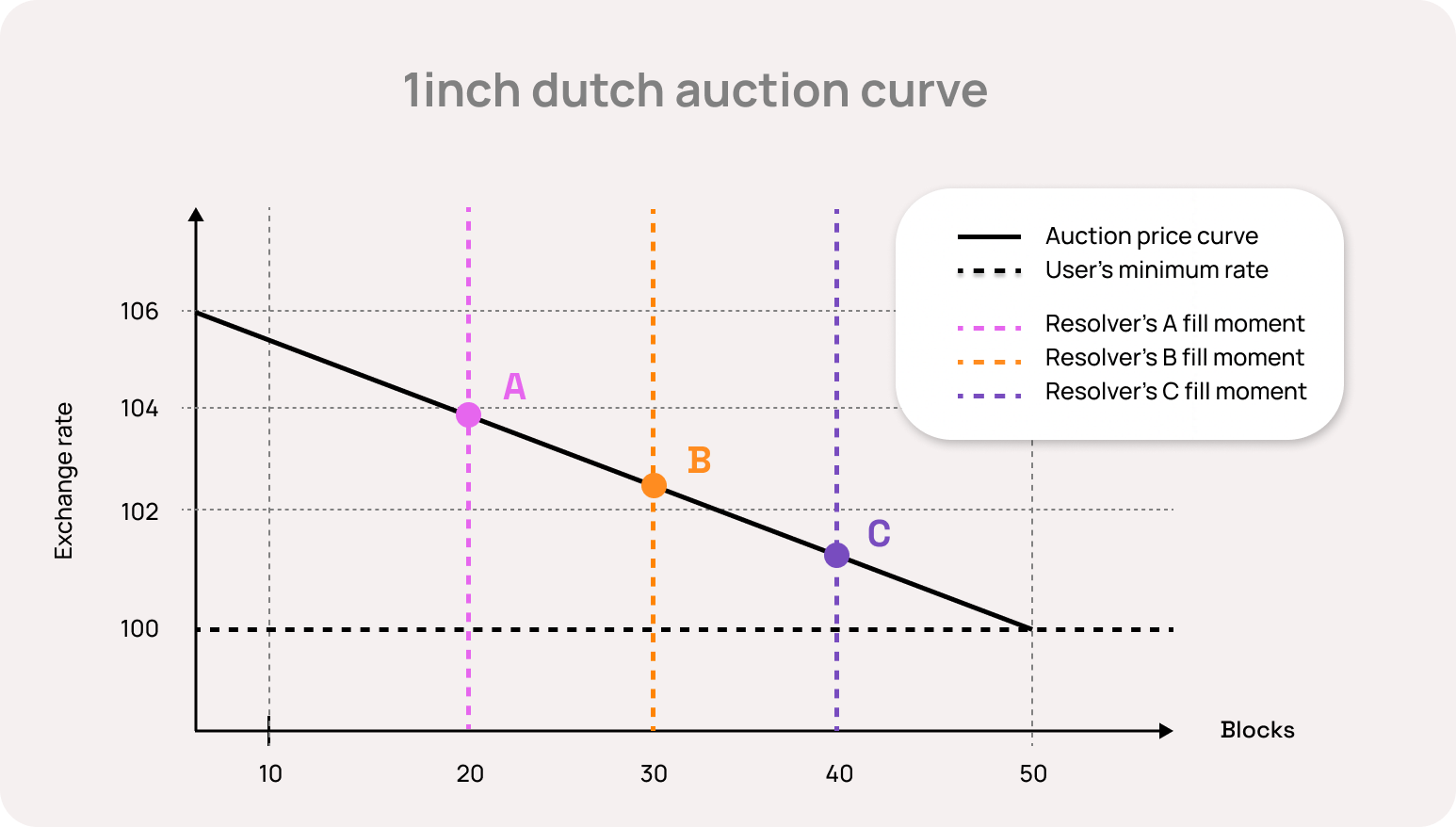
Here’s the multi-resolver auction race:
- Resolver A fills earlier (block 20) at a higher rate, meaning less profit for A, but guaranteed execution.
- Resolver B waits longer, planning to capture more profit, but loses the order because A already filled.
- Resolver C never gets the chance; by the time they’d act, the order is gone.
This illustrates the trade-off: the longer a resolver waits, the closer the price gets to the user’s minimum (more profit for the resolver), but the higher the risk that another resolver executes first.Early fill means less profit for the resolver but faster execution for the user.
Conclusion
For Barter, joining 1inch as an intent-based swap resolver has confirmed our thesis: intent-based markets are not just an experimental layer of DeFi, but an increasingly central part of how large orders are executed. 1inch’s Dutch auction mechanism shifts value capture from extractive MEV bots to structured competition among a handful of professional actors.
1inch volumes present opportunities for resolvers like Barter: with strong routing infrastructure and experience across multiple DEX intent layers, we are well-positioned to convert delegation and governance access into tangible market share. As one of those resolvers, Barter is committed to playing an active role in shaping this market – bringing our cross-protocol expertise to 1inch and helping define the next phase of intent-driven execution in DeFi.
