

The Intent Economy: Single-Chain vs Cross-Chain
- Barter Research × Across
Content
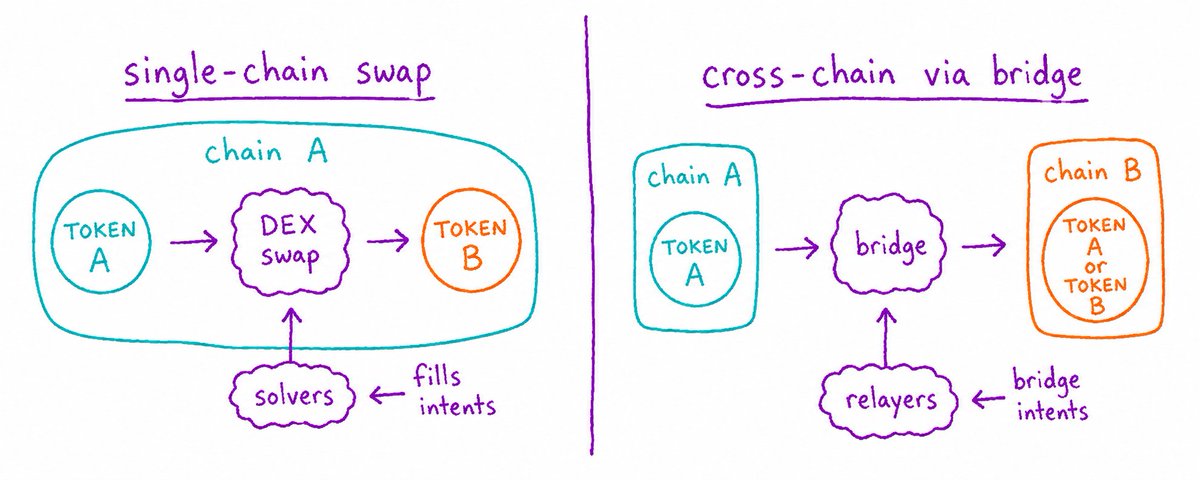
Intent-based execution treats a swap as a goal, not a route. The user signs an intent — input/output assets, minimum out, deadline — and solvers compete to fulfill it.
The same abstraction now spans single-chain and cross-chain execution, but the constraints differ. Single-chain solvers compete inside one settlement environment, routing across public AMMs and private quoting systems. Cross-chain solvers extend the model across domains, adding finality and latency to the execution problem.
This piece is a collaboration between @BarterDeFi (single-chain routing and liquidity infrastructure) and @AcrossProtocol (cross-chain bridge). Together they show how one intent model adapts to two very different execution surfaces.
Execution and settlement
Single-chain overview
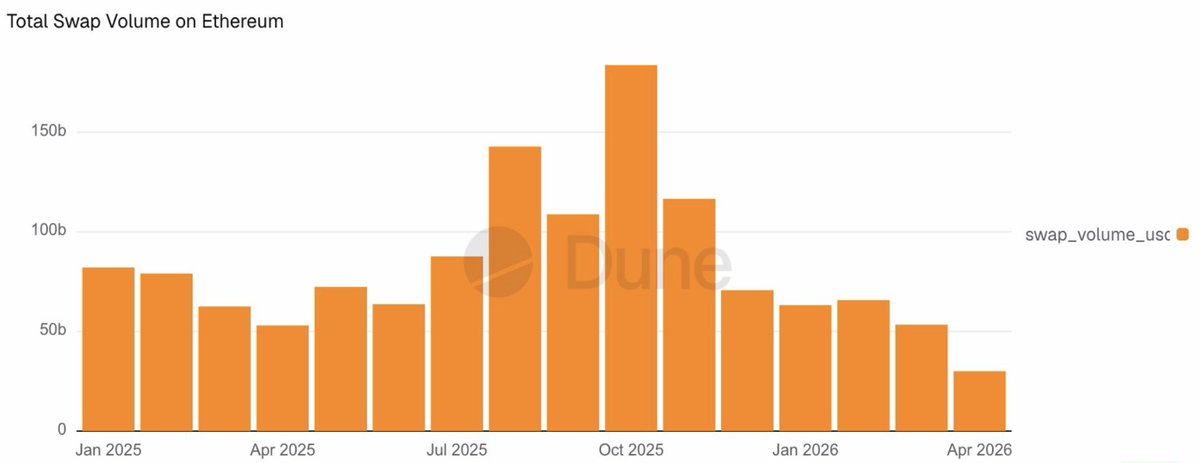
By 2026, Ethereum remains the primary execution layer for single-chain swaps, concentrating the majority of intent-based trading activity. Total swap volume on Ethereum peaked near $185B in October 2025 and has since trended lower, with March 2026 closing around $53B amid broader market cooling.
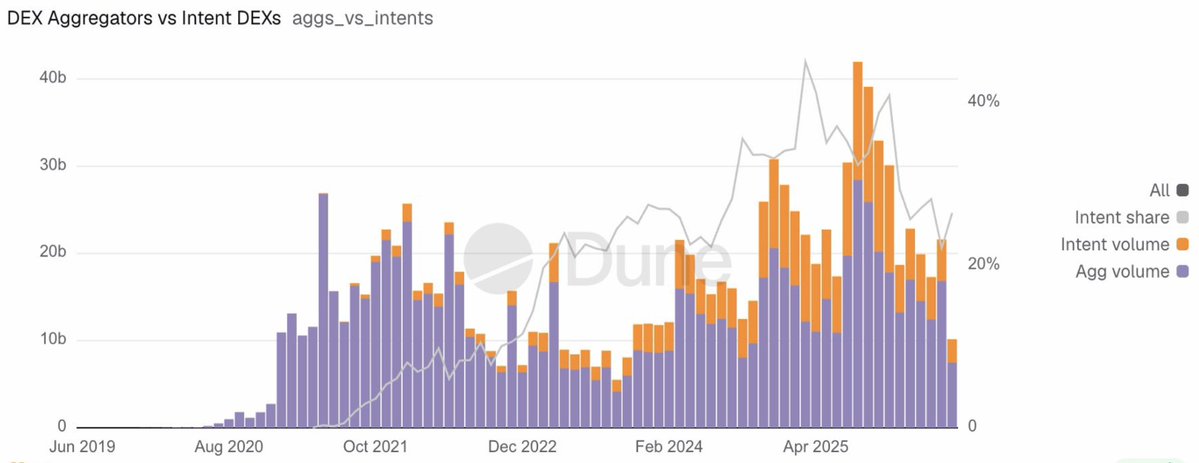
A notable structural shift is the growing share of swaps executed via intent-based protocols. In the most recent month, approximately $3B of Ethereum swap volume was routed by solvers, with intent share oscillating between 20–30% of aggregated DEX volume and briefly exceeding 40% during peaks in late 2025. @CoWSwap remains the dominant intent venue, followed by @1inch Fusion, @VeloraDEX and @Uniswap X.
Single-chain solvers
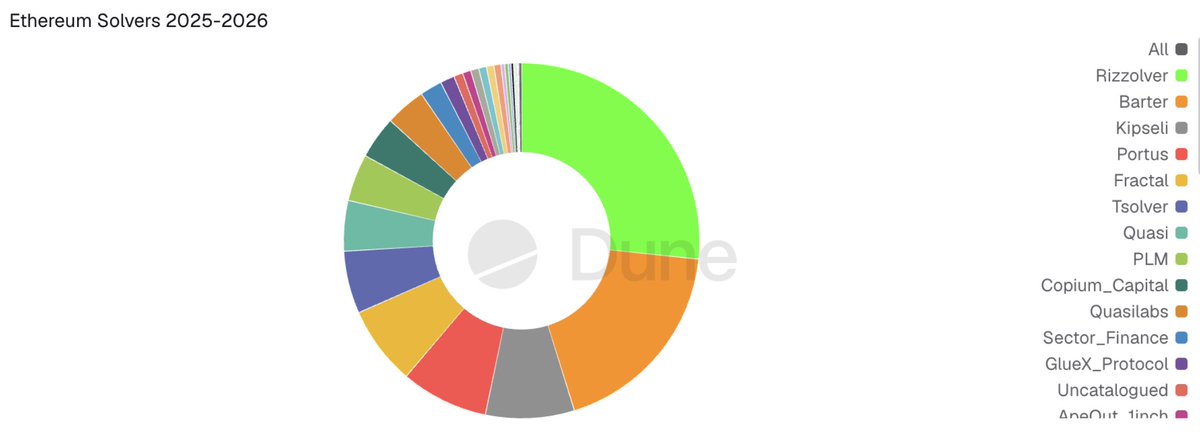
Single-chain solving has evolved into a competitive market. Instead of fixed routing logic, multiple independent solvers submit execution proposals for the same intent. This model was first introduced by CoW Swap, which pioneered solver-based execution on Ethereum, and has since produced a defined solver landscape with clear concentration dynamics.
Across 2025–2026, the two largest CoW Swap solvers remain Rizzolver and Barter, together accounting for roughly half of executed volume.
Behind the scenes, intent-based swaps operate through competitive auctions where solvers bid to execute a user's intent under predefined constraints. CoW Swap introduced batch and later fair combinatorial auctions to optimize execution across multiple orders. UniswapX applies a hybrid model, combining RFQ-style exclusive quoting with a Dutch auction fallback to balance price guarantees and open competition. 1inch uses a pure Dutch auction, where solvers compete on speed and timing along a decaying price curve.
One of the key risks in swap execution is MEV (Maximal Extractable Value), which arises when execution information becomes observable before final settlement and third parties can profit from transaction ordering. On public liquidity, this typically takes the form of sandwiching and backrunning, which worsens realized execution and functions as an implicit cost for the end user. The issue is particularly acute in stablecoin swaps: expectations are near 1:1, explicit fees are tight, and trade sizes are often large, so even small adverse price movements become meaningful in dollar terms.
In recent months, MEV share on stablecoin flows has trended higher, repeatedly reaching 40–50% and approaching 60% at peaks.
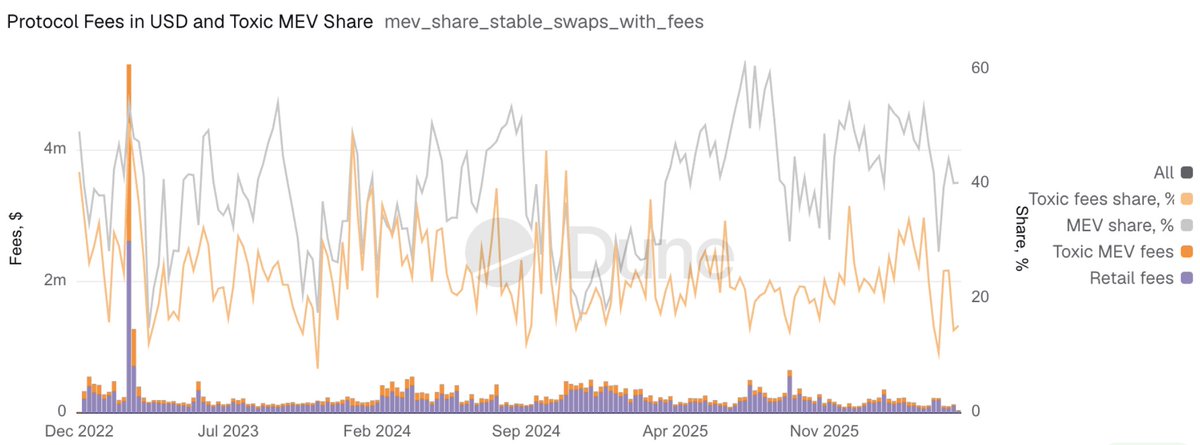
MEV is also an execution and economics risk for the solver itself. Concretely for Barter, MEV pressure increases the likelihood of adverse selection and state changes between planning and inclusion, which can lead to degraded execution quality or reverts.
Cross-chain overview
Cross-chain volume tells a similar story to single-chain. Where Ethereum DEX activity peaked in October 2025 and cooled into early 2026, total bridge volumes have softened in the same window. The story within the category is more interesting: intent-based bridging has moved from research thesis to clearing real flow, displacing lock-and-mint designs as more activity migrates onto L2s.
DefiLlama's bridges dashboard puts total monthly cross-chain volume in the tens of billions across all tracked bridges. The shape of demand is concentrated: stablecoin transfers dominate, and the busiest corridors are L2-to-L2 USDC and ETH-to-L2 flows. Roughly $150B in stablecoin supply now sits across Ethereum and its major L2s, and cross-chain stablecoin volume clears tens of billions per month.
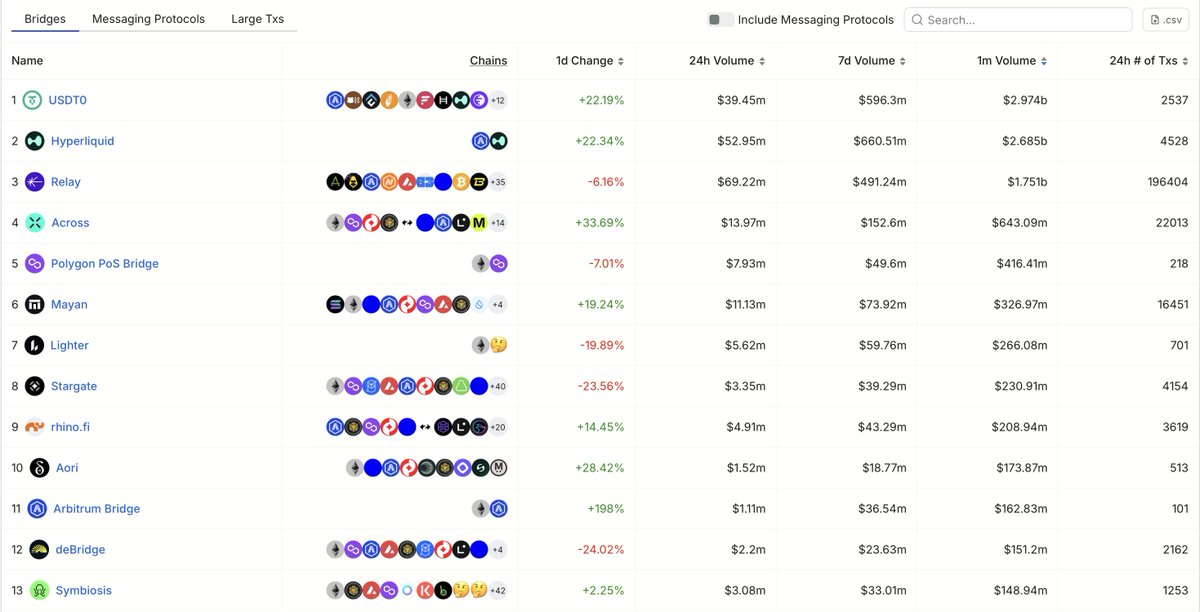
Inside the intent category, Across is the largest intent-based bridge on Ethereum L2s, with $34B+ in filled volume to date. deBridge's DLN and Relay are the other production-scale intent networks, with Mayan operating the equivalent footprint in the Solana corridor. Pool-based bridges (Stargate, Wormhole's token bridge) still carry meaningful volume, but the trajectory is clear: intent-based settlement has moved from an emerging design to production infrastructure.
The standardization layer matters here. ERC-7683, co-authored by Across and Uniswap Labs and adopted into the Ethereum Foundation's Open Intents Framework, has been adopted across 30+ projects, with major L2s including Arbitrum, Optimism, Polygon, zkSync, Linea, Gnosis, Scroll and Starknet committing to OIF support. The practical effect is that solvers and relayers can quote across multiple intent networks from one inventory pool, which compresses spreads everywhere the standard is implemented.
Cross-chain solvers / relayers
A single-chain solver competes inside one state machine. The path from quote to settlement is short, and capital requirements are flexible. Solvers can rebalance between blocks, source liquidity from AMMs at execution time, or run inventory-light. A cross-chain relayer can't. To fill an intent, the relayer must hold destination-chain inventory at the moment the user signs. The intent commits the relayer to a quote, and the relayer is exposed to source-chain finality risk for the entire window between fill and reimbursement. This structural difference produces a smaller, more capital-intensive operator set.
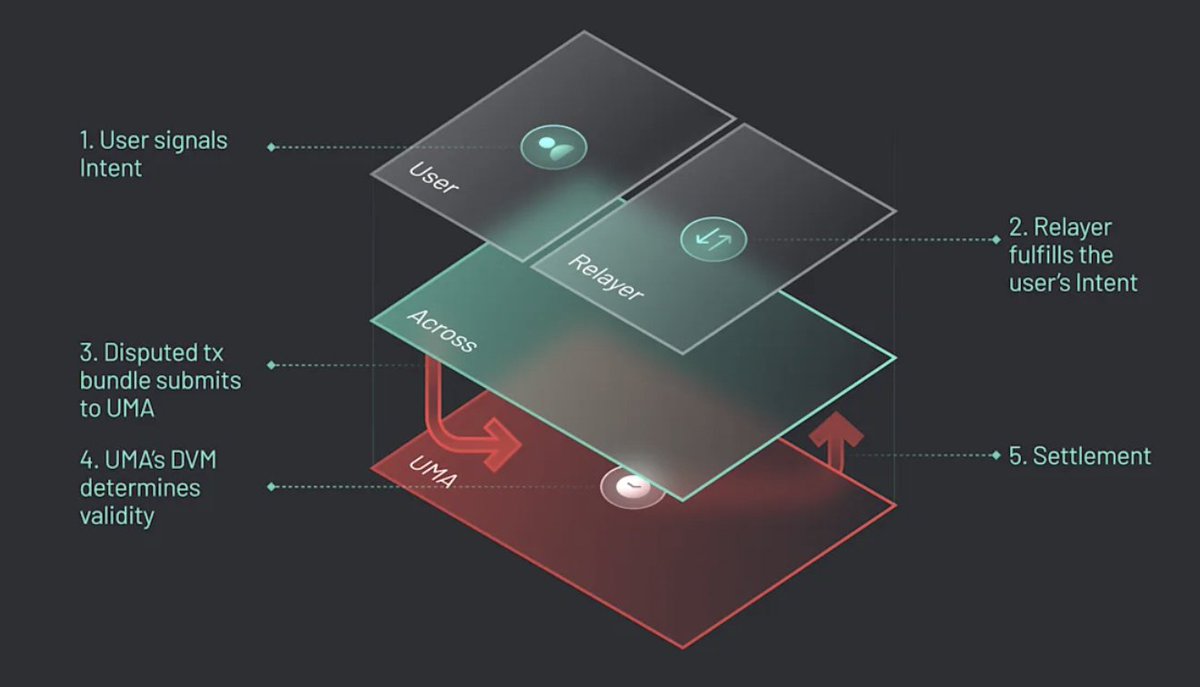
The auction mechanic is also different. Where single-chain protocols use batch auctions, Dutch auctions, or RFQ-with-fallback, cross-chain intents resolve through a faster first-come-first-fill race against the user's quote. Speed of inventory commitment, not bid optimization, is the primary axis of competition. Average fill times of ~2 seconds on Across reflect this: relayers are paid to absorb latency the user would otherwise carry.
One consequence is that inventory remains specialized. A relayer optimized for L2-to-L2 USDC has a very different balance sheet than one quoting Solana corridors. Convergence will likely come asset-by-asset and corridor-by-corridor rather than as a uniform shift.
Liquidity sourcing
Single-chain liquidity
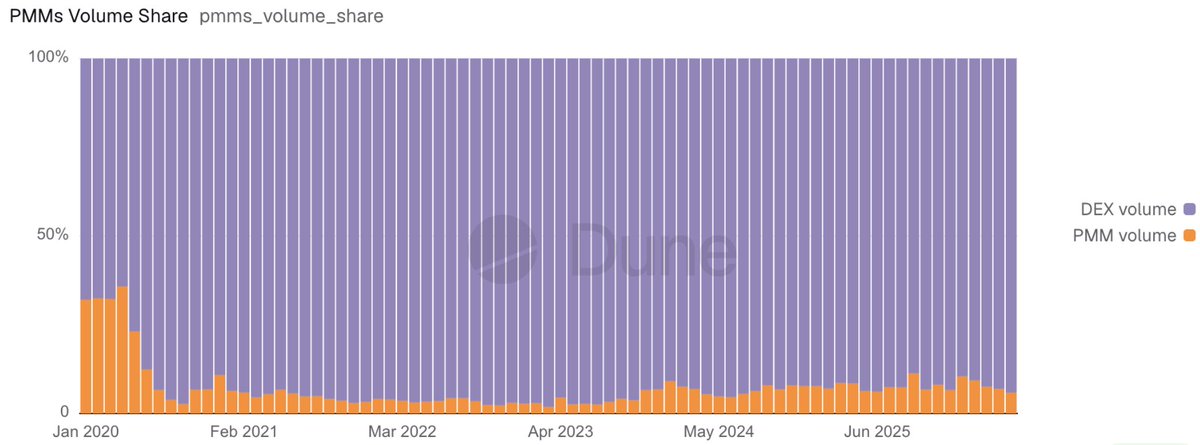
Single-chain swaps on Ethereum increasingly source liquidity from two layers: AMMs and private liquidity. AMMs remain the backbone of the ecosystem, but intense competition between routers and solvers has pushed execution toward tighter pricing, exposing the limits of AMMs for large or price-sensitive trades. To fill this gap, private liquidity has become an essential execution primitive. On Ethereum, this mainly takes the form of Private Market Makers (PMMs), where prices are computed off-chain and liquidity is accessed through RFQs. PMM share has held around 5–10% of total DEX volume.
New models such as Barter Autopilot extend this concept by turning wallet-held assets into a private liquidity layer, allowing solvers to source liquidity directly from user wallets while preserving self-custody. Autopilot acts as a private liquidity source for single-chain execution, complementing AMMs rather than replacing them.
Cross-chain liquidity
Single-chain solvers source liquidity from public AMMs, PMMs quoting via RFQ, and newer wallet-held liquidity layers like Autopilot. Cross-chain intent fillers don't have that luxury. There is no AMM that spans two chains, and no PMM can quote a destination-chain asset it doesn't hold. Liquidity sourcing in cross-chain reduces to one question: does the relayer have the destination asset on hand, right now, at this size?
That constraint shapes everything downstream. A relayer running Across, deBridge or Relay maintains inventory on every supported chain in proportion to expected flow. Active capital management — rebalancing across chains, hedging exposure between fill and reimbursement, sizing inventory to expected daily flow — is what separates production relayers from hobbyists.
This is also why route quality, speed, and cost on a cross-chain intent are functions of the same underlying variable. A well-stocked corridor (USDC between Arbitrum, Base, Optimism and Ethereum) sees tight spreads, near-instant fills, and consistent pricing because multiple relayers are competing with deep inventory. A less-trafficked corridor sees slower fills, wider spreads, and occasional fallbacks to canonical bridges or CCTP because relayer inventory is thinner or absent. The user-visible experience of fast, cheap, predictable bridging is downstream of how much capital relayers are willing to commit to that specific route.
Across's design pushes against the capital efficiency problem in a few ways. A single-sided liquidity hub on Ethereum lets LPs deposit once and have capital deployed across all supported chains, rather than fragmenting LP deposits per-chain. Reimbursements settle to Ethereum through the optimistic oracle, which keeps the trust assumption uniform across the network rather than introducing per-chain validators or multisigs. And the relayer competition is open: anyone with capital and the ability to monitor intents can fill, which keeps spreads competitive on high-volume corridors even as the operator set stays specialized.
The structural takeaway: in single-chain, liquidity is a venue selection problem. In cross-chain, liquidity is a capital allocation problem, and that's why the two surfaces, even running the same intent abstraction, produce different market structures.
Two surfaces, one execution layer
What both designs deliver is the same outcome: fragmented liquidity that behaves like a coherent execution layer. As intent-based systems mature, solvers turn into core market structure, standardizing how trades are expressed, sharpening competition on execution quality, and pushing markets toward lower friction and more predictable outcomes.
Putting this into practice: Barter has integrated cross-chain swaps powered by Across. You can test single-chain and cross-chain execution side by side at app.barterswap.xyz/swap.
Single-chain and cross-chain swaps, side by side.
Barter has integrated cross-chain swaps powered by Across. Compare execution across both surfaces in one app.
Open Barter Swap